
Ritual sacrifice in Second Temple Jerusalem
I want to preface this post about Jerusalem’s second temple, one of the greatest in antiquity, by saying that I’m not a reverent person. Two thousand years ago, I might have thought “Ooh, a fashion parade!” as the High Priest changed vestments five times on Yom Kippur. I might have thought this, but I wouldn’t have said it. And, I’d have stayed out of the restricted zones of the temple, unlike that Roman dickhead Pompey (pardon the Aussie potty-mouth, but in this case it’s warranted; more on him later). In this post we will enter the forbidden courts, venturing closer and closer to the temple’s sacred centre, but only in our imaginations. We will also, as promised in the title, chase the scapegoat out of the eastern doorway, perhaps attaining a little reverence along the way.
The tabernacle
The term “Second Temple” is a misnomer, because it was actually kind of the third. Let’s add to the confusion by going right back to temple zero: the tabernacle.
The tabernacle was a mobile shrine that the Israelites carried with them before they settled in Jerusalem. Made of wood and hide, it was set up when the Israelites made camp; Yahweh gave Moses strict instructions on its dimensions and build. The tent was divided into the Holy of Holies and the Holy Place.
Holy of Holies
The Holy of Holies was the most sacred space, mostly empty, signifying Yahweh’s invisibility and incorporeality. During the tabernacle years, it contained the fabled Ark of the Covenant, which “seems to have been a chest which contained the tablets of the Law and surmounted by two golden cherubim: their outstretched wings formed the back of a throne for Yahweh” (Armstrong). Although Raiders of the Lost Ark claims otherwise, the Ark probably didn’t melt faces or have hieroglyphic carvings of R2-D2 and C-3PO. The Holy of Holies was the most restricted part of the tabernacle, only to be entered by the High Priest and then only on Yom Kippur, the holiest day in the Jewish calendar.
The Holy Place
The rest of the tabernacle, the Holy Place, was open to priests. It housed sacred items: the Menorah, the Table of Showbread, and the Altar of Incense, which were cared for by the priests.
The court
The tabernacle was enclosed in a courtyard, which was open to the ritually pure Israelites.
Ritual purity
Ritual impurity isn’t related to sin or lack of hygiene, but to a person coming into contact with something that made them impure, like mildew, lizards or corpses, or physical processes like women on their period/men’s nocturnal emissions (Magness). Most people were considered impure most of the time, but had to purify themselves to enter the tabernacle/temple and surrounding courts.
Purity was attained by immersion in undrawn water and waiting a prescribed period of time, usually until sundown. Undrawn water means that which is pooled via non-mechanical means, like streams, or designated pools called mikva’ot, which were filled and emptied using channels.
The first temple
The Israelites’ years of wandering came to an end when King David settled on Jerusalem’s eastern hill, around the 10th century BCE. David ticked a lot of must-haves for ye olden kings: did a lot of smiting, beheading, played the lyre (Frankel). However, because he was a man of war, Yahweh didn’t let him build the first temple. This was left to his son Solomon: lover, lyricist, sage.
Solomon’s temple crowned the eastern hill. Much like the tabernacle, it was built according to strict dimensions, twice the size of the tabernacle. It was surrounded by courts, with strict access control. The outer court was open to Gentiles (people who aren’t Jewish), and aptly named the Court of the Gentiles. Further in was the Court of the Israelites, also aptly named and open to the ritually pure. Then came the Court of Priests, and finally, the temple. Within the temple, the Holy Place was gilded and resplendent compared to the one in the tabernacle, with ten ornate menorahs, tables, an altar of incense, carvings. The Holy of Holies was again empty save for the Ark of the Covenant.
Blood sacrifice
One thing we haven’t touched on is the sacrificial altar, which stood in front of the tabernacle, and in later times, the temple.
Animal sacrifice was pervasive in the Mediterranean in antiquity (Mueller). It was a two-way exchange between the gods, who wanted praise and sacrifice, and mortals, who wanted protection. An animal was slaughtered according to strict rules, after apparently giving their permission. (I’m yet to see archaeological evidence of consent forms with hoof and trotter print signatures at the bottom.)
Blood was the sacred life source, which is why it was offered to the gods (Britannica). Part of the animal was burnt on the altar, the fire taking it up to the gods, and the rest eaten by the offerer, their family and friends (Grabbe). It’s worth nothing that meat was a rarity in antiquity, so these gatherings were a big deal. I’d have been the opportunist hanging around to see which family brought the tastiest meat (typical menus included sheep, goat and pigeon, and the odd bull) and attached myself to their party. (Families were big back then, no one would have noticed.)
Like other peoples, the Israelites practised blood sacrifice, but unlike others they only offered to Yahweh, rather than a pantheon of gods. A Roman seafarer, for example, might have asked Neptune for calm seas. In Judaism, animal sacrifice was also a way of transferring sins to the animal in the hope of atonement (Leviticus 16).
Animal sacrifice seems foreign to us now, but in a way the concept lives on. The sharing of Christ’s blood plays a hugely symbolic role in Christianity. And after the second temple was destroyed, prayer replaced blood sacrifices in Judaism.
The second temple
When something went wrong, people in the ancient east believed that they did something to incur the wrath of their god (Glassman). According to the prophet Jeremiah, the people of Judah (the land around Jerusalem) sinned by turning to alien gods and they lacked compassion, exploiting strangers, orphans, and widows (Armstrong). Thus Yahweh let the Babylonian King Nebuchadrezzar conquer Judah in 587 BCE, burn the temple, and exile the Jews (Spaeth).
In Babylon, the exiles began to pray in groups, which were the forerunners of synagogues (Anderson). But synagogues were not substitutes for the temple. The exiles were allowed to return to Jerusalem, and around 539 BCE they built the second temple on the same spot, using the same dimensions as the first. The outer courts were likely different to Solomon’s temple. The mood definitely was:
Instead of being drawn to splendid temples as in the past, Yahweh was more attracted these days by a “humbled and contrite spirit.” The cult of the First Temple had been noisy, joyful and tumultuous. Worship in the Second Temple tended to be quiet and sober. (Anderson)
Pompey the DH
Step into this solemness, Pompey the Great, or as I called him above, Pompey the Dickhead. Gnaeus Pompeius Magnus was a Roman general who was part of the great Roman expansion across the Mediterranean. He had a long history of quashing (rebellions, pirates, enemies of the state). Like most successful Romans, he marked Rome like a tomcat, but with statues and buildings instead of piss.
In 63 BCE, he laid siege to Jerusalem and slaughtered 12,000 locals. Such was his arrogance that he sauntered into the temple, ignoring the rules and moseyed into the Holy of Holies itself.
My parents encouraged travelling, but were adamant that when we entered someone else’s territory, we respected their customs. If I climbed Uluru, against the wishes of Anangu people in Central Australia, my 76-year-old dad would sit me down for a terrifying talking-to even now. I guess Pompey’s dad was more the go-rape-and-pillage-and-make-me-proud kind.
Pompey was surprised to find the Holy of Holies empty, since Roman temples housed ginormous statues of their gods. I wonder whether the concept of an incorporeal god blew his mind? To his credit, he did have the temple cleansed the next day, ordered that sacrifices resume, and didn’t loot it. He redeemed himself a bit, so let’s rename him Pompey Not-a-complete-dickheadus.
The second “second temple”
After Jerusalem fell into Rome’s orbit, it couldn’t really extract itself – the whole Mediterranean was swarming with armed dudes in chainmail, leather skirts and hobnailed boots. But for a time, the surrounding lands of Judea, Samaria and Idumea were governed by Jewish leaders, like the infamous Herod the Great. Say what you will about his ruthless autocracy (Armstrong), he was a keen builder and injected the temple with pizzazz (Rocca).
The temple itself seems to have been renovated rather than rebuilt, but boy did it stand out; according to the contemporary historian Josephus the glaring gold and white marble were blinding (Armstrong). Inside, a magnificent undulating curtain shielded the Holy of Holies from sight, although we might have glimpsed the Menorah, the Table of Showbread, and the Altar of Incense.
The Holy of Holies was built over the foundation stone, an exposed segment of bedrock. Aside from this, it was empty. The Ark of the Covenant was long gone, having disappeared after the Babylonian war.
Blood sacrifices continued at the altar in front of the temple, in the Court of Priests. Offerings were slaughtered swiftly and hung to bleed (Ritmeyer, Jewish Virtual Library). Again, a portion of the meat was burnt on the altar, some went to the priest, and the rest to family and friends:
“Jerusalem’s Temple Mount was an enormous precinct where crowds congregated to feast on sacrificial meat. Because of the warm climate and lack of refrigeration, once an animal was slaughtered, the meat had to be consumed immediately. The inedible parts of sacrifices, such as bones, apparently were disposed of in specially designated areas around the outside of the Temple Mount.” (Magness)
But the Temple Mount was much more than a designated area for a giant feast.
Let’s zoom out to take a closer look.
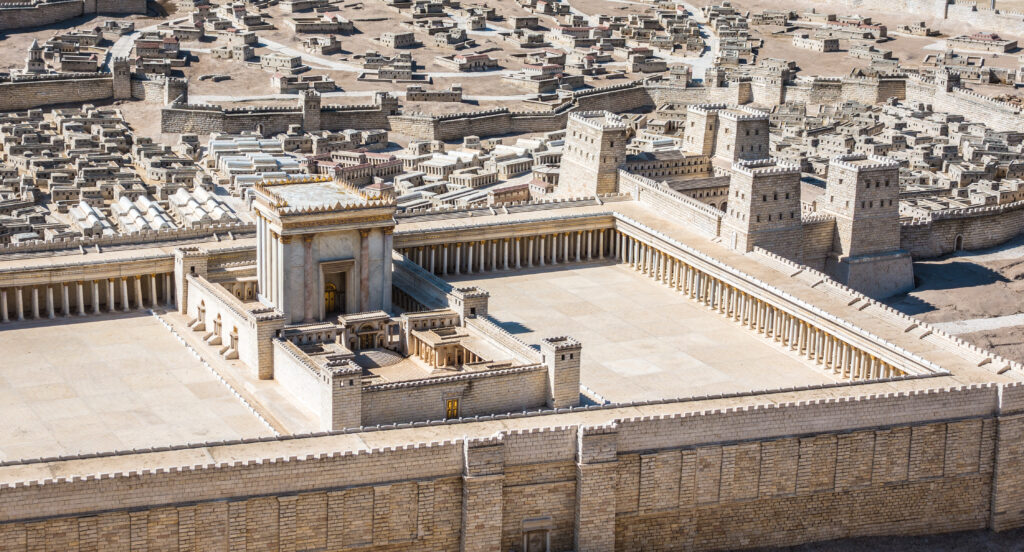
The Temple Mount
The Temple Mount, upon which the courts and temple were built, was roughly 35 to 36 acres! The vertiginous walls, some almost 45m high, were built using enormous stones, some weighing hundreds of tonnes (Magness).
The Temple Mount and its inner courts were like a layered cake, with each step bringing us closer to Yahweh. The Temple Mount itself was a vast rectangular platform surrounded by porches with matrixes of marble columns. Here people were shielded from the elements, so they could mingle, conduct business.
Business was also conducted in the open area, and included buying sacrificial animals, and swapping coins for Tyrian tetradrachmas (silver shekels), which authorities preferred for temple tax because of their high silver content (Magness). Interestingly there was also a sheep pool near the Temple Mount where sheep were washed prior to sacrifice. Note that only unblemished animals could be offered at the altar.
The Temple Mount was open to everyone, including Gentiles, who could even take tours! Imagine the smell of mingling people and animals; the noise – the gabbling in Aramaic, Hebrew, Greek and Roman; the stalls; the excitement of seeing loved ones who came from far and wide during the big three feasts: Pesach (Passover), Shavuot (Feast of Weeks/Pentecost), and Sukkot (Feast of Tabernacles).
The Court of Women
The next layer of the cake was the Court of Women, which was not so aptly named because it was open to all ritually pure Jews, not just women. The court was enclosed in high walls and plaques warning Gentiles, in several languages, to keep out on the pain of death. The Court of Women was a place of music – the choir sang on the semi-circular steps that led to the next layer: the Court of Israelites.
The Court of Israelites
Men took sacrifices up the semi-circular steps—don’t ask me how they got sheep and bulls past the choir—into the Court of Israelites, where they handed them to priests. Women watched animals being offered from galleries above. I wonder how the queasy fared at these feasts; I’d have been passing out every thirty seconds.
Teachings, prayer and hymns may have occurred in these inner courts and perhaps also outside, in the porches.
Tithing
A good many things, aside from tax and animals, were brought to the temple: grain, wine, olive oil, fruit, vegetables, wood. These tithes depended on the season and year, and were distributed among priests, Levites (administrators) and the poor. There were mountains of offerings, which were stored within the walls of the Temple Mount, subterranean chambers, dedicated silos, and storehouses (Ritmeyer)
The scapegoat
Visitors could access the Temple Mount through various grand doors, e.g. via the impressive staircase on the southern end, which led to the underbelly of the temple and out onto the sunny platform. But one set of doors, namely the eastern doors, remained closed except for that one special day in the year: Yom Kippur.
Imagine the throngs gathered in silent contemplation on the Sabbath of Sabbaths, the High Priest awing the crowd in his five different vestments, the knowledge that on this day he entered the Holy of Holies to contemplate invisibility and incorporeality of Yahweh.
A momentous occasion during the ceremony was when a goat was brought to the High Priest, who laid upon it the collective sins of the people (Charlesworth). The eastern gates of the Temple Mount were flung open, the goat forced out. It tumbled down the vertiginous wall to its doom. The temple goers breathed a collective sigh of relief, welcoming the fresh start, free of sin. Irreverent though I am, I can imagine the profound psychological impact that this ritual would have had on all those who took part within the magnificent surrounds of the Temple Mount.
Destruction
Very little remains today of the Second Temple. The Roman occupation of Jerusalem, whether under Roman prefects or vassal kings like Herod, brought great tensions. The two very different cultures never married well. Moreover, no one flourishes under foreign occupation. Over the decades, Judea refused to bend to Roman will. Skirmishes became battles, and battles war, resulting in the Roman siege and eventual annihilation of Jerusalem. Jews were dragged to Rome in chains, the temple treasures displayed before the Roman populace as prized loot.
But was not the end of Yahweh. The Jews turned to prayer, just as they had in Babylon, and their traditions transformed into those that look more familiar to us today, like worship in synagogues.
I usually like to end a post with a laugh, but not today, while the Middle East lingers in peril. The Temple Mount is a sacred site for many people there—Jews, Muslims and Christians, believers, history buffs. My hope is that, like Pompey, we all redeem ourselves a little and treat it and each other with respect.
Further reading for the curious
Anderson, 1978, The Living World of the Old Testament (3rd Edition), Longman.
Armstrong, 1997, History of Jerusalem: One City, Three Faiths, Harper Collins.
Blood-offering, Britannica.
Charlesworth, 2014, Jesus and Temple: Textual and Archaeological Explorations, Augsburg Fortress.
Frankel, 1989, The Classic Tales: 4,000 Years of Jewish Lore, Jason Aronson, Inc.
Glassman, 2008, Lost Worlds: The Bible’s Buried Secrets, Documentary series.
Grabbe, 2010, An Introduction to Second Temple Judaism, T & T Clark International.
Leviticus 16, Bible gateway.
Magness, 2010, The Holy Land Revealed Series, Lecture Series.
Magness, 2012, The Archaeology of the Holy Land, Cambridge University Press.
Mueller, 2020, The Pagan World: Ancient Religions Before Christianity, Lecture Series.
Ritmeyer, 2006, The Quest: Revealing the Temple Mount in Jerusalem, Carta.
Rocca, S. 2008. Herod’s Judaea. A Mediterranean State in the Classical World, Mohr Siebeck.
Spaeth, 2013, The Cambridge Companion to Ancient Mediterranean Religions, Cambridge University Press.