
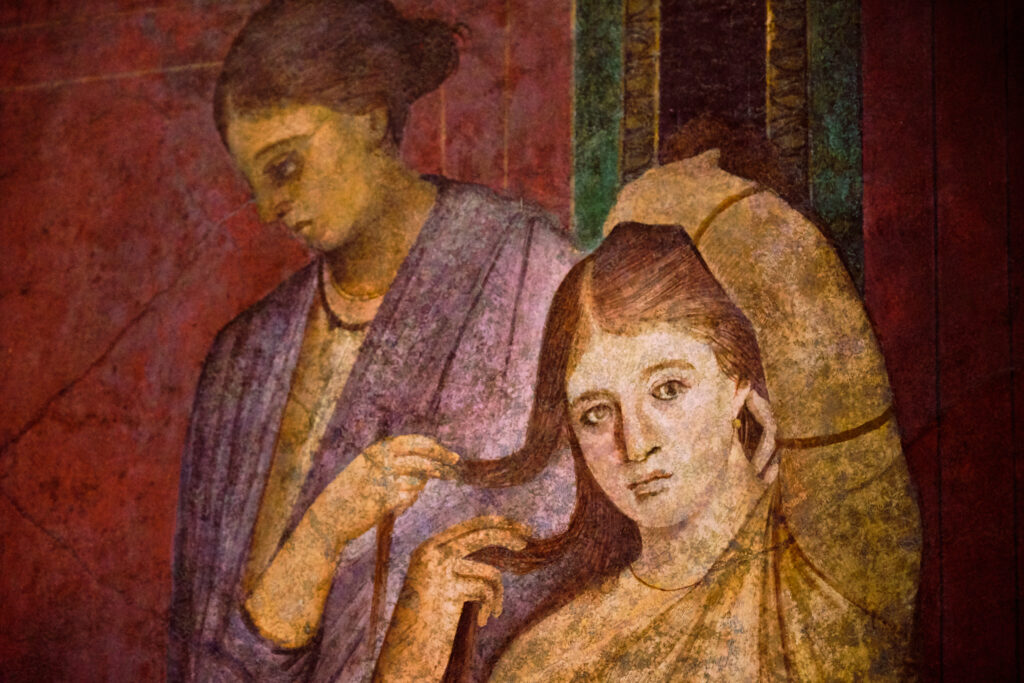
Birth control in antiquity
Trigger warning: This post discusses abortion which may be distressing for some readers. It also contains some gory details about surgery and the effects of medicines, and might therefore not be for everyone.
My maternal grandmother wanted to be an architect. Post WWII, she became a housewife and mother; I never sensed that she was particularly satisfied. My mum was a psychotherapist and the mother of four. She was seriously ill for much of her life; witnessing the strain of her overload could be intense. I’ve also been unwell for most of my life. I’m an olympian-level projectile vomiter (nausea is one of the better side effects of migraines, which is saying something). The thing is that I was lucky to be born in the right location, at the right time, where I had agency over my life and didn’t owe anyone children.
Life would have looked differently in antiquity:
Married women were expected to bear as many children and for as long as they could. The Roman encyclopaedist Pliny (Natural History 7.3.1) mentions a woman from the city of Tralles in Asia Minor, called Eutychis, who gave birth to 30 children over a long span of time. (Malamitsi-Puchner)
Ye gods, thirty!
And if you weren’t a lean mean baby-spouting machine, there was a 30% chance of dying due to complications in childbirth (Christensen).
Now, there weren’t state-wide health campaigns running across the ancient Mediterranean with scribes chiselling statistics into stone as public service announcements. Arguably this wouldn’t have helped, since most people were illiterate, and men prided themselves on having lots of sons, so probably wouldn’t have passed on the message anyway. Women were mostly shut away from public life in courtyards where they cooked, kept house, and raised their young. But they did congregate, gossip, and support each other during pregnancy and deliveries. So they’d have known about the dangers of childbirth, and perhaps tried to wriggle out of their so-called duty.
In this post, let’s imagine ourselves as young women, sitting in the courtyard, patching tunics, listening to the stories of older women. We’ll cheat a bit, taking in research that covers a wide terrain (the whole Mediterranean) and even wider timespan (ancient Egypt to ancient Rome, over 3000 years). After hearing what the elders had to say, I, for one, would have left a hollow clay uterus at the shrine of the goddess Juno…
The great great great grandmother
In our sewing circle, we all give due reverence to the hoary matriarch, making sure that her arthritic frame is supported by plump cushions. Her stiff fingers somehow defy physics as she’s still deft with a needle. Her story might be one akin to that told by the early Ptolemaic Greek poet Posidippus (310–240 B.C.E.), in which he praised an eighty-year-old woman who lived to see the grandchild of her great-granddaughter (Atkinson), that is, six generations of her family. Most of these women would have been around 15 when they bore their first child. As a side note, how did they keep track of who was who in the family, given that it was common to pass on names in various Mediterranean traditions?
Lord of the Phallus
Perhaps the sewing circle was an informal setting where the matriarch, or one of the sassier aunts, prepared young brides-to-be for their wedding nights.
Let’s imagine the bride-to-be as a young Roman maiden. She might have listened to the advice of the older women with growing alarm.
For a start, she’s probably a virgin. (Guys were of course free to shag at will before and after they were married. E.g. Adultery was illegal in the time of Augustus, but sleeping with a slave wasn’t considered adultery.) So, the bride-to-be would have been schooled in the ritualistic elements of that first romantic night in…
The young Roman bride would be led to the marriage bed by her husband, who she didn’t have much say in marrying. Let’s imagine he’s hot to quell our inner shudder. On taking her to the bed, he summoned a whole bunch of deities to make sure the act was fruitful:
the goddess Virginensis [“Virginity”], the father-god Subigus [“Plougher”], the mother-goddess Prema [“Presser”], the goddess Pertunda [“Piercer”], Venus [goddess of sexual love], and Priapus [lord of the phallus]. (Mueller)
Assuming he had the gods’ blessings, his new wife was probably alarmed by the Lord of the Phallus coming at her like a small, dull light sabre in the lamplit room. All she knew was that whatever happened next, she was expected to fall pregnant.Contraception
Most of the women around the sewing circle, especially the proud matriarch, would have reinforced the expectation that the bride falls pregnant. But there may have been other, quieter voices who had witnessed the deaths of many female friends, and of children, as infant mortality was around 30% (Malamitsi-Puchner). Perhaps it was they who pulled the bride aside and imparted some wisdom of their own.
Riddle argued that some women in antiquity controlled the size of their families using various methods such as vaginal suppositories and oral medicines, some of which have been tested for efficacy in modern times.
Enter the medicine man. Or indeed woman. Natural philosophers (that’s a high brow term of scientists in antiquity) spent a good deal of time watching nature. They observed grazing flock, the plants they ate and the effects that these plants had on their fertility. I guess if there’s no internet, you spend your days watching live animal porn and then, more tediously, waiting a few months to see if a lamb or kid pops out. The next logical step was to see whether these plants had the same effect on humans.
Some worked well, some too well, and some of the accompanying advice was just plain weird. In any case, here’s what a desperate woman, who snuck out for a dodgy deal with a poisoner (probably a midwife with a little side-business) under the shade of an aqueduct, might have bought or been told:
- Oral contraceptives included rue, a fernlike plant, herbs of the carrot, pepper and junipers, and the much coveted silphium – no one’s 100% sure about what it was, but think that it was so effective that it was harvested to extinction.
- Vaginal suppositories of pomegranate peel or rind were inserted, using ointments such as old olive oil on locks of fine wool. Alternatives included honey, cedar resin, salve with myrtle oil and white lead, so things that either caused a disgusting mess, or lead poisoning.
- Advice: After coitus, squat, sneeze and drink something cold. (Did natural philosophers observe this behaviour in grazing flocks?)
Abortion
What happened in the case of an unwanted pregnancy? It was a controversial topic then as it still is now. We’ll get onto the morals of the day later. But first, let’s look at the options for obtaining an abortion in antiquity.
There was the surgical method. Knitting needles hadn’t been invented, but Romans had plenty of surgical tools. “Man and Wound in the Ancient World” noted that Romans valued their troops and practised military hygiene (Gabriel). The book was not called “Woman and Wound in the Ancient World,” and it’s safe to say that women were less valued than soldiers. Nonetheless there were specialty instruments for surgery and childbirth like scalpels, curettes and a speculum, a device used to dilate a woman’s opening. They might have even sterilised the tools in hot water before use, like the military surgeons did. While this sounds relatively sophisticated, it’s important to remember that medicine was in its infancy. It was a time when sick people were still categorised according to an imbalance in their humors. We’re talking about bodily liquid humors not hahahaha humour. The human body was thought to consist of four liquids: red blood, yellow bile, black bile and phlegm, which needed to be kept in balance for physical and mental wellbeing. A lot of advice centred on diet, bloodletting, vomiting, and enemas. With this sound theory about the human body, let’s return to surgical abortions. It’s safe and heartbreaking to say that many women bled out. Also, infection must have been rife despite the Romans having a rudimentary understanding of it.
The other, arguably safer, option was a medical abortion. I use this term very lightly. Today medicine is available that is safe and effective. In antiquity, you swallowed a heap of herbs and prayed to the gods to spare your life. Dosage was surely hit and miss, and the adulteration of medicines common. Some oral prescriptions included the aptly named birthwort and barrenwort. Bitter wormwood tea may or may not have worked. I used to drink it to cure hangovers in my twenties, with more or less, mostly less, effect. It is so sweetly disgusting that some women might have vomited. Diseased rye was touted as an effective abortifacient. Google gives a thoroughly disgusting description:
The fungus creates toxic, black, nail-like growths in the grain head. Ingestion can cause severe illness or death in animals, and in humans, it causes gangrenous or convulsive symptoms.
Oh, and it might give you hallucinations.A number of physical regimes were also prescribed to initiate miscarriages: riding, jumping, carrying heavy loads, brisk walking. That just makes me think of a young woman barreling along like an olympic speed-walker, which was probably more dangerous for the onlookers who were dying of laughter.
A side note about Fetal Alcohol Spectrum Disorder
While we’re talking about the effects of various medicines, let’s also consider whether Fetal Alcohol Spectrum Disorder (FASD) was known in antiquity, because the topic has come up in the current medical literature. FASD is a condition caused by alcohol consumption during pregnancy. Children can suffer lifelong harm, including brain damage, physical and mental disabilities. It has been suggested that people in antiquity linked FASD to alcohol consumption through verses such as:“The angel also instructs her as to what she should no longer eat or drink: Behold now, thou art barren, and barest not: but thou shalt conceive, and bear a son. Now therefore beware, I pray thee, and drink not wine nor strong drink, and eat not any unclean thing. (Judges, 13: 3-4) (Abel)
Feldman also cites two other Talmudic passages, Kallah Rabbathi 1 and Nedarim 20b, that “children begotten during a state of inebriety are mentally deficient.” (Abel)
Abel disputes the link to FASD, by discussing the above quotes in the contexts of the larger passages in which they were written. Abel argues that everyone drank wine in antiquity, and that it was a part of a healthy life. However, in my totally unqualified opinion, I’m not sure I agree. Just as natural philosophers observed nature, I want to postulate (my fancy word of the day) that the women of our sewing circle, well versed in pregnancy and raising children, might have made links between wine and the symptoms of FASD.Ethics
Religious and moral attitudes of the day about abortion and contraception were mostly dictated by men. Men were entitled to heirs, so contraceptives and terminations must have mostly been done in secret. But there were notions about the viability of a fetus, the time after conception when the fetus was “animated” or became a little human (Riddle):
- One argument in the Babylonian Talmud says: Can a piece of meat be unsalted for three days without becoming putrid? It must be from the moment that [God] decrees [its destiny], I.e. It’s a human from the time of conception.
- On the other side of the spectrum, Stoics argued that the soul wasn’t presented until birth.
And there are various arguments for windows between conception and viability in Greek, Roman and Judaic literature. So there was a potential margin early on where abortion, say in the first 30 days after conception, may have been acceptable. But generally, “go forth and multiply” was the order of the day.
Infanticide
Thoughts on infanticide varied. It was strictly opposed in Judaic literature (Esler) (Goodman). On the flip side, Roman patriarchs technically had the legal right to expose infant offspring (Abel), and there is evidence, particularly in relation to the exposure of unwanted girls (Bradley). The most common causes of infanticide would have been fiscal pressures due to poverty.
The empty clay uterus
The empty clay uterus is a product of my imagination, well, the empty part is. Women left all sorts of votive offerings at shrines, to ask for the gods’ help or to thank them (Mueller). Many of these were related to health concerns. It seems that some women may have offered clay uteruses, although this is disputed (Graham).
I imagine that as a young woman, listening to the women in the sewing circle with great curiosity and dread, I’d have taken steps to stay alive and childless.
While other, more honourable women might have attended the Lupercalia in Rome, to be struck by the thong of naked young priests, to ensure fertility (the mind boggles as to how rituals are born and evolve), I’d have commissioned a decidedly empty clay uterus. My offering to Juno would have been accompanied by whispered prayers, asking for a long and barren life, even if it meant social shame.
Even in today’s world…
Full disclosure, I’ve never been pregnant. Aside from various health issues, the thought of it terrified me. I ogled my friends’ expanding bellies with fearful curiosity, and listened to their tales of horror about prenatal classes where women fled clinics weeping about all the things that could go wrong. Childbirth is dangerous, and not to be taken lightly. According to an ABC article “more than eight million women each year globally suffer from postpartum haemorrhage, accounting for 25% of all maternal deaths due to pregnancy and labour related causes.” The loss of mother or child is tragic. One of the saddest moments in my life was my friend’s stillbirth, her son’s tiny casket. I thank Juno that I was born in the right time and place for sovereignty over my body.
Further reading for the curious
Abel, 1997, Was The Fetal Alcohol Syndrome Recognized in the Ancient Near East? Alcohol & Alcoholism.
Atkinson, 2012, Queen Salome: Jerusalem’s warrior monarch of the first century B.C.E., McFarland & Co.
Bradley, Cartledge (ed), 2011, The Cambridge World History of Slavery, Cambridge University Press.
Christensen, 2023, Mothers’ lives in ancient Greece were not easy – but celebrations of their love have survived across the centuries, Brandeis.
Esler, 2000, The early Christian world, Routledge.
Gabriel, 2011, Man and Wound in the Ancient World: A History of Military Medicine from Sumer to the Fall of Constantinople, Potomac Books Inc.
Gerathy, Glanville, Haydar, 2018, NSW abortion clinic ‘safe access’ bill passes with overwhelming support, ABC News.
Goodman, 2007. Rome and Jerusalem: The clash of ancient civilizations, Allen Lane.
Graham, 2017, When is a womb not a womb? The Votives Project.
Malamitsi-Puchner, Konstantakos, 2023, Evidence, hints and assumptions for late pregnancy in the Ancient Mediterranean and Near East, Wiley.
Mueller, 2020, The Pagan World: Ancient Religions Before Christianity, Lecture Series.
Riddle, 1992, Contraception and abortion from the ancient world to the Renaissance, Harvard University Press.