
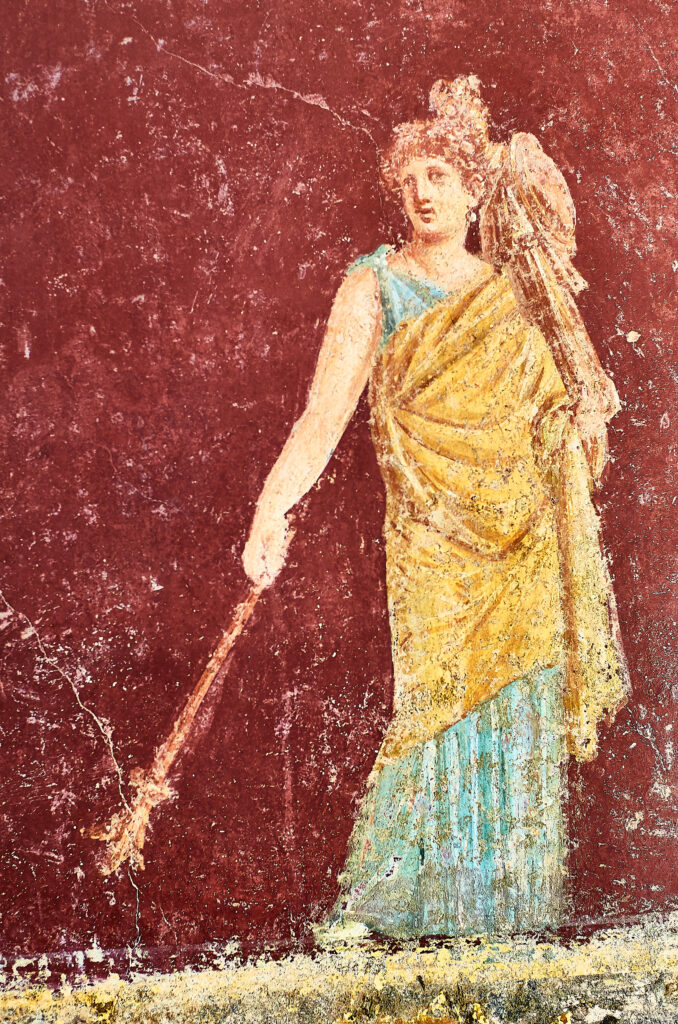
Fashion faux pas in ancient Rome
Fashion trends are increasingly embracing all genders, but one or two conservative monocles might still pop out at the sight of a Western man strutting around without his trousers. Conversely, in ancient Rome, one or two monocles (rock crystal lenses?) might have popped out at the sight of a German in tight trousers and a shirt-length tunic. After all, civilised men wore tunics that reached their knees, leggings only when it was cold, and knee-length breeches only if they were in the military. They did not parade about in tight full-length trousers that showed the shape of every limb (Tacitus). In this post we’ll take a closer look at fashion and fashion faux pas in ancient Rome and the provinces. Much of what you’ll read below is a paraphrased summary of Croom’s excellent book on Roman fashion, with a few references from elsewhere, and as always, a lookout for amusing quotes and anecdotes.
Clothing
Making clothes
Today fast fashion is everywhere. Most of us don’t think about the effort it took to harvest the natural fibres (wool, cotton, silk, linen) or manufacture the synthetic fibres (polyester, nylon, acrylic, …) on our backs. We don’t contemplate the hours it took to tease out the threads and weave them into fabric, or the dying, the design, the patterns, the notions, … For me this was just something that went on outside of my realm, a tedious manufacturing process. But my interest was piqued, not consciously, but subliminally when I binge-watched Project Runway, or when I was mesmerised by paintings of clothes (Vittorio Reggiani, Jan van Eyck, Johannes Vermeer, Gerard ter Borch, …). In art galleries, I’ve always been drawn to folds, lustre, silhouettes, but I couldn’t name the fabrics.
I wished I’d listened to my mum, a trained tailor, about the importance of pre-washing, how silk frayed, how woven fabrics could be draped when sewn on the bias. But I was too riddled with teenage angst when she sewed clothes for us, desperately hoping that the end products would look store-bought. I didn’t think further about any of this until I got hooked on The Great British Sewing Bee, an amateur sewing contest, which included some hilarious sewing catastrophes, and zingers like, “I can see you’ve done boning before.” Around this time, I began looking at clothes in antiquity for the novel I’m writing, and my conscious curiosity was piqued.
Raw material
Most clothes in ancient Rome were made from wool or linen; cotton and silk were luxuries from the far east. Both the plant matter (linen) and animal hair (wool) were teased into strands from a distaff (a stick with flax or wool) and spun using a spindle (a rod used for twisting). The distaff and spindle were symbols of womanhood, although rich women tended to hover over the slaves in a supervisory capacity, rather than doing actual work.
Weaving
Shuttles thread the weft between taut warps to produce rough textiles or tissue-thin sheets, depending on the materials used and the skill of the weaver. Weaving is one of those all-consuming, repetitive addictions that can steal hours of time; when I was little I loved making crude woollen wraps for my toys. The looms of antiquity were more sophisticated than the wooden frame that sat on my desk. The most common were warp-weighted looms, which rested against walls and were used to make rectangular fabrics. The other type were freestanding two-beam looms for making seamless tubes, e.g. for dresses.
Cloth
Fabric wasn’t limited to woven goods; it included materials such as furs, felts, leather, and knotted or netted fabrics. Sometimes fabrics like silk and wool were combined to reduce the cost, but all cloth was expensive because of the amount of work that went into producing it.
Cut
Most clothing was based on two simple concepts. The first was to sew two rectangular pieces of cloth together, leaving holes for the head, arms and legs, e.g. a tunic. The second was to manipulate single pieces of rectangular cloth, e.g. a large piece could be draped as a toga, or fastened at the neck or shoulder to serve as a cape or cloak; smaller pieces were used as leg wraps, breast-bands, etc.
In antiquity clothes were draped, not structured – no one minced about in a corset, much less an Issey Miyake flying saucer dress. But draping did lend itself to eye-catching variations, like the peplos, a double-skirt created by pulling an extra layer of fabric over the belt, or gap-sleeved tunics, which were made by using fasteners at intervals down the arms, instead of seams.
Colours
Today’s fashions are incredibly colourful; we flap around like exotic butterflies, thinking nothing of it. In antiquity most people wore the drab uniforms of the masses, natural shades of grey and brown. Wearing bright colours meant that you had dosh and liked to flaunt it.
The easiest way to achieve variation in colour was with wool; white wool was much easier to dye than linen. Ovid mentions purple, sky blue, water coloured, saffron, green, amethyst, chestnut, almond and wax yellow.
Purple was a decadent colour that was limited to the wealthy, and later, the emperor. Tyrian purple was made from crushed snails. It radiated in the light and didn’t fade, but that wasn’t the only reason it attracted attention. It reeked… which some served some people:
Martial refers to a woman who wore purple clothes day and night so that the smell of the dye concealed her body odour (Croom).
As a side note, Magness pointed out that if we were to travel back in time, we’d either die of disease, or stench.Red came a close second to purple, and was the colour of the army, but was mostly worn by officers.
White, especially the white toga for men, was the symbol of purity and worn for campaigning, ceremonies, holidays, weddings and birthdays. Sulphur fumigation was used to whiten the toga, and their wearers must have smelled like lingering farts. So much for emanating purity.
Blacks and greys symbolised mourning and misfortune. It was also common to let one’s appearance slide during mourning, e.g. shabby beard, unkept hair.
It goes without saying that people didn’t galavant around in mono-coloured tunics and robes; patterns and coloured borders/hems were popular. Metal could also be threaded into or embroidered onto cloth for that extra bling, but had the nasty side effect of being stiff and heavy, which evokes images of the Cybermen in Dr Who.
Cleaning and mending
Clothes were cleaned in mixtures of sulphur, ash and urine. The unlucky slave spent hours knee-high in this noxious mixture, trampling on sodden clothes and sheets in a stone vat. Mary Beard does a great impression of the fuller’s dance, singing included. Clothes were regularly patched, and stripes/hems/borders replaced, to make those precious tunics last for as long as possible.
Cost
Owning clothes wasn’t a given, and sets were often bequeathed in wills or formed part of marriage settlements and contracts.
For example, 3000 denarii bought “a Numidian hooded cape, a woman’s third quality dalmatic tunic from Tarsus, a first quality face-cloth from Tarsus… or a four-wheeled carriage (minus the ironwork) (Croom).
The lucky few had seasonal clothes, e.g. longer-sleeved tunics for winter, leg wraps, and scarves. Skins and furs were associated with barbarians.Slaves had the worst deal, compelled to wear whatever they were given. In the second century BC, Cato, in his typical prescriptive style, listed the suggested clothing allowance for male farm slaves:
“a tunic three and a half feet long, and a thick cloak (sagum) every other year. When you issue the tunic or cloak, first take up the old one and have patchwork made of it” (Croom).
The second-hand trade was profitable, and larceny even more lucrative, depending on your circumstances, integrity and audacity.
Pockets
No such thing. Stuff was carried in pouches or bags.
Fashion faux pas
There are far too many sartorial blunders to list (or indeed know about), so we’ll take a look at common social expectations and bungles, things to keep in mind in case you stumble into a time machine and wind up in a stench-riddled Rome around 2000 years ago.
Rome
Men
Roman men’s tunics proclaimed status: senators and knights wore white tunics with broad and narrow purple stripes respectively (Dunstan). The lower classes wore plain, unbleached woollen ones. Tunics were knee-length or longer and worn with a belt. No belt = bad = slave or poor.
The toga was the national costume for the male Roman citizen, but worn mainly for ceremonial occasions, because it was cumbersome and uncomfortable.
Martial pointed out that in the Italian countryside ‘on the odd Ides or Calends you might take out your dusty toga and give it a shake.’ (Croom)
Juvenal remarked that ’there are many parts of Italy, to tell the truth, in which no man puts on a toga until he is dead.’ (Croom)
However, some men liked to declare their status, especially if it was recently attained:Short togas were always worn by those unable to afford the full width toga. In the first century Horace talks of a rich ex-slave ‘parading from end to end of the Sacred Way in a toga three yards long’ to show off his new status and wealth.’ (Croom)
Faux pas? I leave it for you to decide.
Some men liked to appear wise:
“The pallium was a Greek garment, which came to be considered the Greek equivalent of the Roman toga as a form of national dress. Because of the Greek association, it was considered the correct dress for philosophers and scholars, or those who wished to appear cultured. It was worn without a tunic for those who wished to pose as a Greek philosopher.” (Croom)
Sounds risky – you might want to take more than a passing glance at your school books before donning the pallium sans tunic.Speaking of nudity, what about going commando? Loincloths were certainly worn as outer wear by farmers, fishermen and gladiators. But underwear wasn’t universal.
“It seems likely that people wearing short tunics, such as soldiers, wore underwear, while those in less danger of exposing themselves did not bother.” (Croom)
I didn’t realise that soldiers were so modest.
I could go on a whole tangent about military uniforms, but there are plenty of reenactment societies who could do a better job. Let’s focus on one standout item: footwear. If you land in the distant past and hear the clackety-clack of hobnailed boots, you’re near a soldier, run!
Most men wore normal sandals, or the odd special shoe-boot when forced into a toga. A major no-no was wearing comfortable, light house-shoes outdoors, and clunky, grubby, work shoes inside the home.
Romans didn’t really wear headwear except for religious ceremonies (and of course the army offered a spectacular array of helmets). It was probably best to leave speciality hats, like your freedman’s brimless, conical cap, at home, if you were recently emancipated, to avoid drawing attention to your past enslavement.
Short hair and shaved faces were the norm; copying the emperor was a safe-bet.
Modest amounts of perfume, such as balsam and cinnamon, were acceptable; in fact, not wearing perfume was considered unsophisticated and rustic (Olson). Attempts to improve physical appearance—shoes with raised soles, wigs, curled hair, oiled hair, plucked bodies, beauty patches—raised eyebrows among haughty peers, as did wearing jewellery, apart from signet rings.
Apparently crossdressing was considered effeminate and derided (Croom, Olson). I doubt that this was always the case in private, but publicly, Rome was a very conservative society.
Women
High class women dressed for respectability and honour. The stola was the uniform of matronhood, similar to the toga for men. The matron wore a tunic, which was covered by the stola—a bulky, strappy dress—tied under the breasts with a girdle, and draped herself in a long, unwieldy shawl-like cape call a palla, which could double up as a veil (Dunstan). Or did she?
The image of the Roman woman muffled in drapery specified an ideal moral system, not necessarily social practice. (Olson)
Some matrons flaunted their bodies by wearing transparent silks, and were labelled as unchaste; it was even said that they “invited” attacks. You’d have to be a brave, and stupid, assailant to molest a wealthy woman, who was outwardly protected, not only by her bevy of attendants, but by her physical display of wealth (gold, pearls, emeralds, …). Cheap knock-offs, e.g. terracotta-bead necklaces, or iron earrings, were less likely to bestow popularity or protect against harassment.
I assume that what women actually wore were outfits on the scale between the chaste ideal and flipping the bird at the establishment. As a general rule of thumb, the bigger the tunic, the more affluent the woman, because the poor needed shorter, less voluminous outfits for practical labour.
Wealthy women differentiated themselves from men by wearing colours that were preceded by suitable adjectives: sky blue; sea blue; walnut brown; almond brown; acorn brown; golden yellow; pale yellow; dark green; amethyst violet or purple; pale pink. Unsophisticated colours like garish greenish yellow and cherry red were left to the lower classes. I understand why garish colours might be unacceptable, but don’t ask me how cherry got a bad reputation.
In terms of coiffures, poor women pulled their hair back and got on with it. Conversely, upper class women spent hours under the fingers of their hairstylists. Wealthy women copied the coiffures of the women in the imperial court, and played with wigs, semi-wigs, golden hairnets. A number of accidents involving curling tongs and hair dye, resulting in burnt hair, scorched scalps and hair loss. There’s a lot to be said for simplicity.
Makeup was to be tastefully applied (similar to our “no makeup makeup” look), because artificiality denoted a desire to be seductive, which men found deceitful. White skin signified a lady of leisure rather than one who was exposed to outdoor labour. Women shielded themselves with parasols and whitened their skin with lead pastes, which were known to be poisonous (the lead, not the parasols) (Olson). They used kohl eyeliner and fretted about their eyelashes:
Pliny the Elder wrote that eyelashes fell out from excessive sex and so it was especially important for women to keep their eyelashes long to prove their chastity. (Croom)
Eyeshadow was made from blue azurite, or poisonous green malachite. False teeth came from bone, ivory and paste, replacing rotting ones. Eyebrows were plucked and darkened. Sleek hairless bodies were desired. Women drenched themselves in perfumes in order to smell “healthy.”As with men, footwear mostly consisted of openwork sandals, although women’s shoes had more delicate thongs than men’s, and were sometimes bejewelled. Thick soles were good for wet pavements and making the wearer taller. Sometimes women were closed shoe-boots.
Women wore breast-bands to give the breasts lift in order to change their silhouettes. It must have taken hours of practise not to end up with the demented proportions of a Picasso. Bands were also used to strap down breasts for physical activity, such as ball games at the bathhouse. Women wore briefs for physical activity and during their periods.
As with in so much of human history, women’s attire revolved around attracting a husband:
“And as a careful mother at the approach of her daughter’s lover does all that the trembling hand can do to enhance the charms in hopes of a proper marriage, often readjusts dress and girdle, confines her breast with bands of green jasper, gathers up her hair with jewels, sets a necklace about her throat, and hangs glistening pearls from her ears.” (Olson)
But women could circumvent social expectations in order to wear other outfits. For example, some women apparently joined cults just for the outfits. (It’s probably best to read the fine print before doing that.)
Children
In short, babies were swaddled, and kids given large tunics to grow into. Large tunics, hand-me-downs and patched-up tunics may have caused social embarrassment. I’m not condoning theft, but let’s just say I knew people who stole school uniforms to escape the shame of poverty, and we grew up in a less stratified society than ancient Rome.
The Provinces
It’s difficult to know the extent of fashion faux pas in Rome’s provinces around and beyond the Mediterranean. These areas contained small contingents of Romans, wealthy local ruling classes that adopted Roman lifestyles, and rural dwellers who maintained their own traditions. According to archaeological evidence, men seemed to adopt Roman fashion more readily than women. I find this surprising, since women were the ones with an eye for fashion. I guess they didn’t have Vogue, or maybe it was that men travelled more, so could more readily emulate Roman fashion.
Greece
The older Greek culture initially influenced Roman fashion, including tunics, pallae and military cloaks. Croom didn’t report anything terribly salacious about Grecian outfits in Roman times. Men generally wore calf-length tunics, mantles and sandals. They were often unbelted, which might have raised Roman eyebrows. Women wore belted tunics with elbow-length sleeves, and mantles. Slave women wore tube-dresses over undertunics.
Syria
Syrian men dressed like Greeks, or Parthians, the latter wearing mid-thigh length tunics, sometimes with side splits, long sleeves and long trousers. While this is an example of a short tunic, it would have only turned heads closer to Rome. Besides, Parthian trousers were baggy, narrowing at the ankle, unlike the eye-popping, tight-fitting German trousers. Parthian footwear was somewhat noteworthy – highly decorated, soft ankle boots for indoor use, and plainer counterparts for outdoors.
Women wore tube-dresses over undertunics, which were fastened with sizeable brooches. In Rome, it was men who wore brooches to fasten cloaks. Syrian women wore turbans that were covered in knee-length veils, and the ostentatious wore multiple necklaces, earrings, a stack of bracelets, anklets, rings. Ok, ancient Syria’s edition of Vogue sounds more interesting than that of ancient Rome; I can see why these women chose to stick to their own fashions.
Egypt
Evidence from Egypt offered a very disappointing entry to Antiquity Vogue. Egyptian men tended towards white tunics, with stripes, and a mantle draped over the shoulder, and women seemed to wear sewn, rather than Roman gap-sleeve, tunics.
Judea
Judeans didn’t leave behind portraits from the Roman period, likely due to the Second Commandment, which prohibited graven images. It’s assumed that Jewish men followed the basic Greek costume, but with longer tunics and sleeves. Their mantles were adorned with fringes, as God commanded the men to attach tassels to the four corners of their garments. Women were veiled, like elsewhere in the east (Goodman), and may have dressed similar to Syrian women. Men tended to white, and women to colour, except red, which was considered the colour of non-Jewish women.
Gauls, Germans and Celts
My people! (I was bon in Austria.) My people were called the-trouser-men, the tight-trouser-men, no less. Add to this, both men’s and women’s garments were brightly coloured, coupled with ostentatious jewellery, metallic ornamentation, and even gold and silver belts (Powell). These busy ensembles had Roman eyes popping, and I have to say that I’m a bit proud that our fashion turned Roman heads, instead of vice versa, albeit 2000 years ago.
I’ll leave it on this happy note. All hail the Barbarian Met Gala!
Further reading for the curious
Beard, 2012, Lost Worlds: Meet The Roman, Documentary series.
Croom, 2000, Roman Clothing and Fashion, Tempus Publishing Ltd.
Dunstan, 2000, Ancient Rome, Rowman & Littlefield.
Goodman, 2007, Rome and Jerusalem: The clash of ancient civilizations, Allen Lane.
Magness, 2010, The Holy Land Revealed Series – Lecture Series.
Olson, 2008, Dress and the Roman Woman : Self-presentation and Society Routledge.
Powell, 2011, Eager for Glory: The Untold Story of Drusus The Elder, Conqueror of Germania, Pen & Sword Military.
Tacitus, Germania, Chapter 17.