
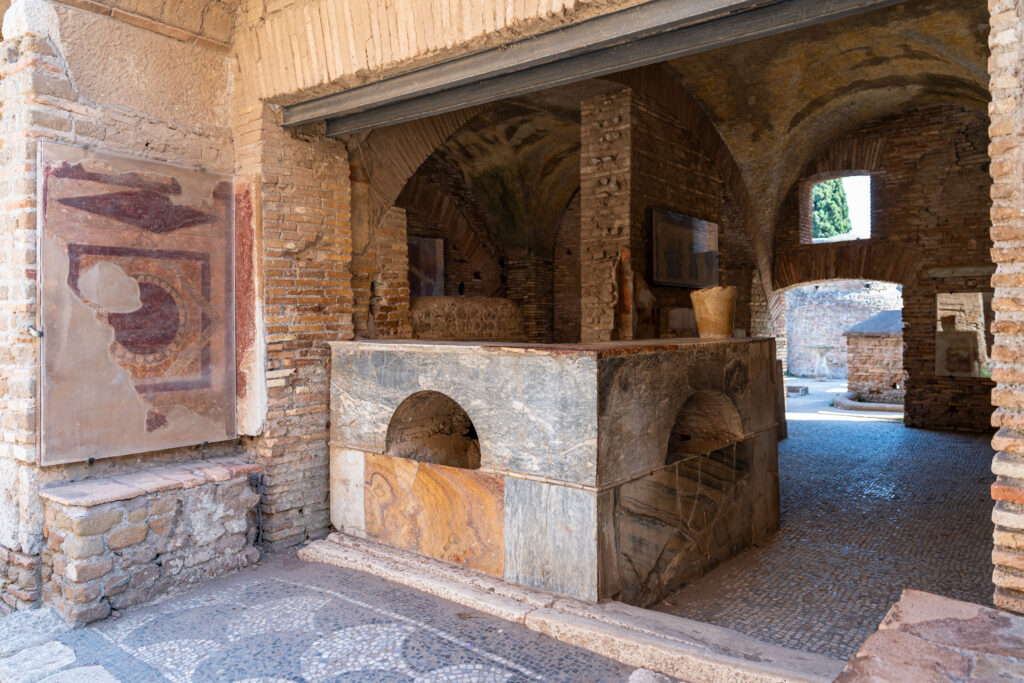
Eating in ancient Rome
Whenever people talk about reincarnation someone is convinced that they were Cleopatra. They’re thinking: All the signs are there – I like diadems, powerful Romans, and will exit this world with dramatic flair by engaging the bitey services of a massive cobra. (Hear me out, I’ll get to Roman food in a second.) If reincarnation is a thing, it’s surely a numbers game. Most of us would have been plebs, the great unwashed who spent their days stirring lumpy concrete, bearing children, or staying awake on sentry duty. Unlike Cleopatra and her Roman suitors, who dined reclining attended by a flurry of slaves bearing platters and jugs, we’d have wolfed down a slice of bread on the way to hard graft. If we had spare change, we bought an apple as a treat. The more enterprising among us might have stolen it from the vendor’s wicker basket. Life was not all roses. In this post we’ll look at who ate what and where in ancient Rome. We will, of course, also discuss the title of the post, the almost immortal sausage.
Meals and meal times
The novel I’m currently writing is set in Rome and Jerusalem about 2000 years ago, when the BCEs became the CEs. My investigation into food began with the obvious – menus and meal times. I compiled a rudimentary list from Dunstan and Goodman:
- Breakfast: bread dipped in wine, or cheese and fruit.
- A light lunch: fish or eggs and vegetables, with wine.
- Main meal – 3 or 4pm – three courses: eggs, shellfish, olives, salad, raw vegetables; followed by meat, poultry and fish with cooked vegetables and a variety of sauces; and then dessert of sweet delicacies and fruit. Lots of wine.
- Drunkenness was often a social problem in ancient Rome.
We get a vague sense of Roman eating and drinking habits, but no clear idea where the food came from, and whether everyone from Julius Caesar to the humble docker reclined for a three course meal at the end of a hard day’s graft.
The food availability pyramid
As I read on, it seemed that the Romans had a food pyramid of sorts. It wasn’t like the modern one, which is designed to curb our cravings:
- Base (eat most of): Vegetables, legumes, fruit, whole grains
- Middle (eat moderately): Dairy, meat, fish, eggs, nuts
- Top (eat sparingly): Sweets, fat, oils.
The Roman food pyramid, my great contribution to the literature, is based on wealth and the availability of food:
- Base (staples): bread; wine, a drizzle of olive oil
- Middle (pay day): Vegetables, legumes, fruit, dairy, eggs, nuts, a sprinkling of pork, poultry or fish
- Top (won the lotto): Meat
Even this arrangement is optimistic. During antiquity the Lord’s Prayer was spoken for the first time, and the line “Give us this day our daily bread” held very real significance. As a semi-obedient Catholic kid, I was confused because we had daily bread, so I asked for daily cake. The lord did not deliver and my waistline was grateful.
Food shortage was a constant threat in the Roman empire. The city of Rome itself had to feed a million people, and needed a constant supply of grain, which it initially got from Sicily, and later North Africa. Grain was imported on big-bellied merchant ships. Their agitated crews were on the constant lookout for pirates, who could upset social order by blocking or stealing the grain. The old adage of giving the people bread and circuses was steeped in the very real fear of disenchanted hungry masses. In fact, Rome fed some 200,000 male citizens for free in a welfare program (Holleran). I say fed, the men were given grain which they had to turn into bread. Not an easy feat. Most Romans were squashed into tiny shared rooms in tall apartment blocks called insulae, “islands” (Beard), so they had to take the grain to the miller and hire a space in the baker’s oven (Holleran). Stamps may have been used to claim ownership of bread. One of my friends marks her donuts with post-it notes that say “Mine,” so the practice is still going strong two millennia later. Rome’s other 800,000 inhabitants also needed bread. Some were rich, some middle class, slaves were fed by their masters, but many of the inhabitants lived from hand to mouth. On a good day, they’d have scoffed a nice fluffy slice of wheat bread (bread looked like puffed wheels of pizza), on a bad day it was chewy barley as bread or porridge.
Said bread was washed down with the democratic drink, aka wine, available to all, but, like bread, of varying quality. Wine was diluted with water and, if you had the dosh, sweetened with honey. Everyone drank it, even children. Rome’s drinking water was often polluted by putrid particulates (feel free to admire my alliteration), so wine was added to make it safer to drink. Different times, different times! The price of wine depended on the quality. At one tavern in Pompeii, a jug ranged from about 1 ass to 4 asses. In this case an ass is currency, not a donkey or a fool. Sometimes inferior wine was “sweetened by thickened grape and fruit juice which had been boiled in lead vessels” (Thommen). The price of being poor was chewy bread chased down by disgusting fruity wine and a bout of lead poisoning. In the words of Yzma from The Emperor’s New Groove, “They should have thought of that before they decided to become peasants.”
Olive oil could be considered a third staple. Rome ran on oil (Holleran), which was used for food, in lamps, as massage oil and in medicine. Everyone had a drizzle, even the poor. As a side note, rancid olive oil amphorae (jugs) ended up on a huge mountainous dump called Monte Testaccio, which still exists today.
The middle section of the Roman food pyramid could be labeled “almost-vegetarianism.” In antiquity most people were almost-vegetarians out of necessity. They might have described themselves like some vegetarians do today, “I’m vegetarian… except sometimes I eat fish. … and chicken. … ok, I’ll have a steak if it’s going.” Their diet consisted of everyday vegetables: cabbage, garlic, onions, beets, radishes, lettuce, celery, cucumbers, which, if you think about it, are red, white and green like today’s Italian flag. Supplementing this patriotic dish were legumes: beans, lentils, peas, and chickpeas, which were not only widely available but believed to be an aphrodisiac. On a very good day, Roman legumes were flavoured with pork, which will soon take us to the title of this piece “The cured sausage is almost immortal sausage.” Soon, but not yet.
Let’s talk about other almost-vegetarian ingredients first. Romans enjoyed cheese, eggs, mushrooms, fish, salt and herbs. They flavoured everything with a salty fermented fish sauce called garum—like we do ketchup, or maybe that’s just me—which Heston Blumenthal described as “liquid armpit.” Times were tough, and salt and spices pricy. Sweeties like pastries were also expensive, as was honey. The odd piece of fruit–figs, grapes, apples, and pears–were seasonal treats.
The foodies in Rome had a better time with a choice of weird and wonderful from home and afar. Snooty food markets like the macellum sold meat and fish, oysters from the North Sea, foie gras (which the Romans invented), parrotfish, peacock, i.e. the sorts of things that graced Queen Victoria’s table. Dishes were supplemented with spices from the East, lemons and pomegranates from Africa, plums from Damascus, and dates from the oases. They washed all that down with a cup or two or ten of first-class Falernian.
Romans did drink other things, like water (despite the putrid particulates), milk, and even beer, which, in Rome, was stamped the cheap and nasty drink of the poor.
The cured sausage
Let us finally turn our attention to the immortal sausage! This blog is as much about regurgitating information as it is the fantastic finds I made while researching. The article Sausage and meat preservation in antiquity (Frost) is brilliant. It is a combination of critical thinking, scientific experimentation, finding insults in the literature, and briefly considering a dubious experiment.
The critical thinking
Frost’s article reminds us that meat was scarce in antiquity. Sheep and goats were used for milk and wool. Cows were milked and oxen put to the plough, and weren’t “a source of meat until the day the old ox fell dead in the traces.” “The pig,” they go on to say, “Produces neither wool nor milk, therefore one might wonder at the prominence of pigs mentioned in the Greek and Roman diet. What the pig does produce is more pigs.” Very true! Presto, we finally have some flavouring for our patriotic vegetables and our bland, but sexually stimulating, chickpeas. (Apologies to all you vegetarians and vegans out there. I’m one of those hypocrites who claims to love animals, while chomping on crispy bacon.)
The scientific experimentation
Frost made ham and sausages using instructions left by Greeks and Romans, and it worked. The meat withstood the test of time without the need for refrigeration.
The insult
Frost found a delightful insult in the literature, which gives us brief pause before eating a sausage.
By definition, [the sausage seller] was the lowest of the low. … He carries a display table, knives, intestines, tripe, and other offal and sells at the gates where salt fish is sold… It is implied that he mixes dog and donkey meat into his sausages. We conclude that sausage must have been a cheap and common snack for the crowds coming and going in the city and that, as from time immemorial, sausages were made of the cheapest leftovers and were easy to adulterate.
Granted, do we truly know what goes into a sausage, even now?
The tempting experiment
Frost:
As I have inspected the mountains of cured sausages heaped on long tables in the street markets of Provence I have been tempted to put a small marker on a distinctive looking sausage and see how often it shows up on the same vendor’s table as he moves from market town to market town, week after week… such a sausage has a remarkable shelf life because of its natural preservatives.
Are we not now also tempted to try this little experiment?
The conclusion
Frost arrived at the excellent saying, “A sausage that is cured raw is almost immortal.” The Greeks and Romans found a way to boost their everyday meals, which surely made life that little bit better.
Our article hasn’t quite come to an end. I want to talk about where and how food was consumed, give Roman health advice and leave you with some recipes.
Dining
For most Romans, food was takeaway, consumed near the bakery or market stall or ambulant trader in the streets. Sometimes people ate with mates in the taverns that sold wine for asses.
Rich Romans dined at home, or in the home of someone else, because only the riffraff ate out. Their meals were boiled or roasted in ovens or braziers. They had dedicated dining rooms with groups of three couches around a table, and were attended by hovering slaves bearing platters and jugs. And, the super rich, a pepper slave, at the ready with his pestle and mortar.
Diners reclined by propping themselves up on their left elbows. I may have thought too deeply, but did said diners get the equivalent of a tennis arm, given that the right arm was doing all the reaching for food? Did diners walk lopsided, after hours of propping themselves up with their left arms? And what if you were left-handed? Did you embarrass yourself with awkward, uncoordinated right-handed eating? Or did you turn to face the other way, with your face suddenly uncomfortably close to the host’s?
The placement around the table was hierarchical, with the host on the left, the high status guest in the middle, and the lesser guest on the right, in the U-shaped setup. During the empire, Roman women moved from chairs to reclining with men. Ah, such liberation! Banquets used wide couches, with three to a bed, so nine people fit around a table. Imagine getting trapped between two boring lads with halitosis.
Dinners were also opportunities for hosts to flaunt their wealth (Matz). The host Virro, for example, drank from a gilded cup, was attended by well-groomed servants, ate wheat bread, lobster, freshly caught mullets, goose liver, truffles and fruit. His guests were given leaking cups, “a servant so vile and grim no one would want to meet him in a dark alley, a minuscule plate with a shrimp and half an egg, served with greens so old they would more aptly be called browns, an eel from the sewers of Rome, and scraps of hard, crusty bread, of the kind that could shatter a man’s incisors.” Honey, next time he invites us, tell him we’re busy. What? I don’t know. Make something up, like we’re going to a crucifixion.
Healthy eating
The physician Celsus compiled a great encyclopedia on his medical work, including advice on healthy eating (Matz).
- Healthy food: harsh, sour, and moderately salted foods; unleavened bread: soaked rice or barley; roasted or boiled birds; lean beef and meat; pig parts, including feet, ears, and womb; lettuce; olives; cooked gourds; cherries, mulberries, pears, apples, pomegranates, raisins; dates; soft eggs; oysters, snails, fish; and very hot or very cold foods and drinks.
- Unhealthy food: anything lukewarm; anything too salty, sweet, stewed, or fatty; spices or seasonings, such as thyme, catnip, mint, or sorrel juice.
It’s a strange mix of common sense and bizarre advice, not dissimilar to Celsus’s treatments for mental disorders which included music therapy and massage on the one hand, and bleeding, frightening patients and enemas on the other.
Recipes
We leave you with some fine Roman recipes from (Matz) to try at your own leisure. Or you may just want to watch Heston’s Roman feast where he prepares, among other things, crispy pig nipples and an ejaculating cake.
The wayfarer’s honey refresher
(So called because it gives endurance and strength to pedestrians)
Flavour honey with ground pepper and skim; in the moment of serving, put honey in a cup, as much as is desired to obtain the right degree of sweetness, and mix with wine, not more than a needed quantity; also, add some wine to the spiced honey to facilitate its flow and the mixing.
As a side note, travellers often complained about over-priced, bad food at roadhouses. Some things never change.
Fine Ragout of Brains and Bacon
Strain hard-boiled eggs with parboiled brains [calf’s or pig’s], the skin and the nerves of which have been removed. Also, cook chicken giblets. Put this aforesaid mixture in a saucepan, place the cooked bacon in the centre, grind pepper and lovage [herbs]. And to sweeten, add a dash of mead. Heat. When hot, stir briskly with a rue whip, and bind [thicken] with roux [flour].
Peas (Supreme Style)
Cook the peas with oil and a piece of sow’s belly. Put in a saucepan: broth, leek heads, green coriander, and put on the fire to be cooked. Dice tidbits [finely chopped meats]. Similarly cook thrushes or other small game birds, or take sliced chicken or diced brain, properly cooked.
Further cook, in the available broth, Lucanian sausage and bacon; cook leeks in water. Crush a pint of toasted pignolia nuts; also crush pepper, lovage [herbs], origany [herbs], and ginger. Dilute with the broth of pork.
Take a square baking dish, suitable for turning over; oil [it] well. Sprinkle [on the bottom] a layer of crushed nuts, upon which put some peas, fully covering the bottom of the dish. On top of this, arrange slices of the bacon, leeks, and sliced Lucanian sausage. Again cover with a layer of peas, and alternate all the rest of the available edibles in the manner described, until the dish is filled, concluding at last with a layer of peas.
Bake this dish in the oven, or put it into a slow fire, so that it may be baked thoroughly. [Next, make a sauce of the following]: Put yolks of hard-boiled eggs in the mortar with white pepper, nuts, honey, white wine, and a little broth. Mix and put it into a saucepan to be cooked. When done, turn out the peas into a large [dish], and mask them with this sauce, which is called white sauce.
Further reading for the curious
Beard, 2012, Lost Worlds: Meet The Romans, Documentary series.
Dunstan, 2000, Ancient Rome, Rowman & Littlefield.
Frost, 1999, Sausage and meat preservation in antiquity, Greek, Roman and Byzantine Studies.
Goodman, 2007, Rome and Jerusalem: The clash of ancient civilizations, Allen Lane.
Heston, 2009, Heston’s Feasts: Roman, Documentary series.
Holleran, 2012, Shopping in Ancient Rome, Oxford University Press.
Matz, 2001, Daily Life of the Ancient Romans, Greenwood Press.
Thommen, 2012, Environmental History of Ancient Greece and Rome, Cambridge University Press.