
Fighting Roman oppression
Trigger warning: this post includes graphic depictions of the Roman occupation of Jerusalem, war and suicide.
The Roman oppression of Judea and the surrounding lands isn’t an inherently funny topic, but hey, let’s try to find a joke or two in my research about it. After all, when life gets rough, a good laugh always helps.
History
Let’s begin with a brief history of Jerusalem and its surroundings in terms of occupation.
Jerusalem is also known as the City of David, because David liked the joint and moved in. He may have smote a few Jebusites along the way (Armstrong), but hey, it was the Bronze Age – when you don’t have Netflix, you smite. So David moves in. Then his son, the great Solomon—lyricist, lover, sage—builds a rather impressive temple on top of the hill.
In true biblical style, there was a lot of begetting, the progeny being King Zedekiah. We’re now well into the Iron Age, when the Babylonians are enjoying a bit of expansionism themselves. They besiege Jerusalem and drag Zedekiah away in chains 586 BCE (Goodman). To his credit, he did try to sneak out.
Long story short, the Persians take over and the Jews return from Babylonian exile to rebuild the Jerusalem temple in 539 BCE (Schwartz).
Next comes golden-haired Alexander the Great, who thinks Hellenism is the bomb and sets about converting huge swathes of territory, albeit with the pointy end of his sword. Jerusalem and the surroundings weren’t spared. Like everyone they got one or two alleged benefits: gymnasia, a universal language (Greek), and a few new political and philosophical ideas to discuss over dinner.
But you don’t simply convert because someone with flowing blond locks tells you it’s for the best. A prominent family of Jews known as the Hasmoneans fought back against Greek oppression and told them, in no uncertain terms, where they could stick their philosophies. Henceforth, the Hasmoneans ruled not just Judea (the land around Jerusalem), but also Idumea (the south), Samaria (the centre), Galilee (the north), Perea and Transjordan (the east), and the Mediterranean Coast (the west).
After more begetting, the Hasmonean Alexander Jannaeus became king. Unfortunately he wasn’t a poster boy for benevolent rule. In a fit of rage he once crucified 800 Judeans in a single day (Atkinson). Things settled a bit when he kicked the bucket and his wife Queen Salome took over, no mean feat for a woman in an age where women were locked away from prying eyes (Atkinson). But all good things come to an end; her successor and son seemed to take after his old man.
Enter the Romans in 64 BCE. Ok, there’s a complex civil war going on in Judea and its surroundings, but ultimately the Roman general Pompey overruns Jerusalem and the whole region becomes a vassal of Rome.
At first Rome installed a puppet king, Herod, who was a Roman-phile if ever there was one. Boy did he have a thing for aqueducts, latrines, games, not to mention a bit of Caesar worship. Fancy a Jewish king building multiple temples to multiple gods! (More on Herod below.)
After Herod died, Rome was more or less in charge, either through puppet rulers or their own prefects.
The Roman occupation was long, lasting from 64 BCE to the destruction of Jerusalem in 70 CE. This was followed by a second revolt in the 130s CE and the complete erasure of Jerusalem.
In this post we’ll look at the time leading up to the destruction of Jerusalem in 70 CE, and the fall of the Masada stronghold in 74 CE. By these dates, Rome had effectively won.
The optimistic years
In the beginning, Rome’s annihilation of Jerusalem and the surroundings wasn’t a foregone conclusion. Like when the Greeks took over, Romans brought new ideas, useful things like plumbing and toilets, and also introduced Judea to the world.
Herod
Arguably, the main propagator of Roman-ness was Herod, who reigned around 37 BCE – 4 BCE. He was a rather colourful character, to put it mildly, but he did put Judea on the world map.
There had been years of conflict following Pompey’s initial seizure of Jerusalem. Herod’s bromance with Mark Anthony gave him an army to seize Judea and the surrounding lands (Rocca). Herod was a half Jew – his mother a Nabatean, so viewed with some suspicion by the Jews (Goodman). But he strove to be connected with the glorious pasts of David and Solomon and set about aggrandising his kin and himself (Rocca).
The Jerusalem temple was reasonably large when he took power (recall that the Jews had rebuilt it after returning from Babylon), dominating the top of a hill. But Herod wanted to blind visitors when they first set eyes on Jerusalem.
For the foundations, and the new city wall, he settled on some rather large stones, the biggest so large that it could fit one hundred elephants. One could argue that Herod stimulated the economy by having his people shlep around ridiculously large stones. But you can almost hear the haulers grumbling, “You think he’s compensating for something?”
Atop the northeastern side of said impressive wall, the newly renovated temple rose into prominence, and was a contender for Grand Designs if ever there was one. Some features as described by Josephus:
Now the outward face of the Temple in its front . . . was covered all over with plates of gold of great weight. Thus, at the first rising of the sun, it reflected back a very fiery splendor, causing those who forced themselves to look upon it to turn their eyes away, just as they would have done at the sun’s own (blinding) rays. But this Temple appeared to strangers, when they were at a distance, like a mountain covered with snow. For, as to those parts of it that were not gilt, they were exceedingly white. On its top it had spikes with sharp points, to prevent any pollution of it by birds sitting upon it. (Charlesworth)
Herod was busy building other grand edifices in Jerusalem:
- Mirrored twin palaces;
- Three towers, two were bellicose sentries with battlements and turrets, the smallest a delicate layer of colonnaded palaces, which was named after his favourite wife;
- The Antonia fortress, named after Mark Anthony; and
- Herodium, an enormous palace, including a mausoleum where he’d be laid to rest.
He also built winter palaces in Jericho and Masada. The Jericho palace was an opulent playground with pools and gardens and a Roman bathhouse (Magness). The fortress at Masada, which will feature towards the end of our story, was an even more impressive beast. Situated high on a desert plateau, overlooking the Dead Sea, Masada was a self-contained fortress on an enviable defensive position, which contained provisions, including water reservoirs, if the occupants were ever besieged. Herod being Herod added a Roman bathhouse, elaborate Mosaic floors, and a reception hall (Magness).
When he wasn’t just aggrandising himself and his people, Herod set about appeasing his pagan rulers. And worshipping them. He founded the port city of Caesarea Maritima, complete with a harbour built on underwater concrete walls and a temple to Caesar Augustus. (Herod kind of sidled away from Antony and towards Augustus after Augustus came out on top in the Roman civil war.) He founded Sebaste, in Samaria. (Incidentally Sebaste is Greek for Augustus.) And he built Caesarea Philippi at the base of Mount Hermon again, named after Caesar and complete with a temple for worshipping his Roman overlord. (Rocca)
What did the Jews make of his exploits? There were probably mixed opinions. I assume that some people considered his unctuous fawning necessary for his and their own survival. Besides, he was so good at sycophancy that Judea was one of the few client states that didn’t pay tribute to Rome (Rocca). He even managed to wrangle the post of president of the Olympic Games (Armstrong). And Pagan worship was fine so long as it didn’t defile the temple. Besides, Herod was Jewish, sort of.
On the flipside, Herod was a narcissist who ran a police state (Rocca), and occasionally offended his own people with stupid acts like erecting a blasphemous golden Roman eagle over the temple, and dishonouring the high priesthood by making it a political office (Armstrong). The local Jews were willing to lay down their lives in the face of such insults. So the tiny rumblings of rebellion against Rome began.
But there were also those who, having witnessed Herod or some of the mad Hasmoneans, thought that direct rule by Rome was better than having a “bad” Jew on the throne. After Herod’s death, the emperor shared this view and put prefects in charge of Judea and the surroundings. But things got worse:
Those who wanted direct Roman rule now got their wish – and probably lived to regret it. Roman rule was for Roman benefit. The Roman governors were often ignorant of local traditions and customs, and apparently often did not care, anyway. The ten-year governorship of Pilate (26–36 CE) was a series of clashes with the Jews over various issues; even the Roman historian Tacitus rated his administration poorly. Direct Roman rule over Judah lasted for 35 years and reminded people how much better off they had been under Herodian rule. (Grabbe)
Pilate thumbed his nose at important Jewish traditions. He hung a blasphemous image of the emperor from the Antonia Fortress, overlooking the temple, threatened to kill everyone who protested, stole money from the temple to pay for an aqueduct, … (Armstrong).
Philo described Pontius Pilate as:
“naturally inflexible, a blend of self-will and relentlessness,” and speaks of his conduct as full of “briberies, insults, robberies, outrages and wanton injuries, executions without trial constantly repeated, ceaseless and supremely grievous cruelty.” (Magness)
“Pilate was removed from office after executing a group of Samaritans who had followed their leader to Mount Gerizim in search of tabernacle treasures.” (Magness)
Resistance
Those prefects who came after him weren’t much better. It was time to start fighting back. In the 40s, a group of Jewish assassins was born, who were known as the Sicarii. Their name came from a curved dagger, called the sica, that could hook a man or reach around a shield. They attacked in broad daylight, knifing Romans and collaborators, before concealing their weapon and melting back into the crowd. I don’t know about you, but I’m too much of a coward to join a resistance group. Maybe if I just keep my head down, the Romans will go away. And, even if I did, I think I’d have done myself the most damage when returning the curved blade into my robes. But it’s hard to imagine alternatives when you’re subject to the whims of an indifferent master, and your whole identity is being belittled and then stripped away.
Assassinations became skirmishes, skirmishes battles, and battles war.
The First Jewish Revolt
70 CE. A Roman siege wall surrounded Jerusalem’s actual wall, the one with Herod’s enormous stones. The legionaries in the Roman towers picked off Jewish sentinels, who responded with fire from archers, slingshots, anything at their disposal. For a time, no Romans crossed the no man’s land between the two walls for fear of being doused with hot oil from above. The people in the city starved. They fought over water and scraps of bread in the narrow, twisting streets.
Enormous siege engines rumbled towards Jerusalem, along the indefensible flat northern fields, between the crucifixes of those who’d managed to tunnel out of the city.
Onager slings stretched and released boulders that crippled Jerusalem’s wall. Catapult arms pitched payloads of equal measure. The Romans poured through the smashed city gate and up grappling hooks, infesting the city like rats.
The surviving Jews were sent to Rome in chains. Their temple and city was destroyed. The slaves and loot were used to finance the building of Rome’s Colosseum.
Masada
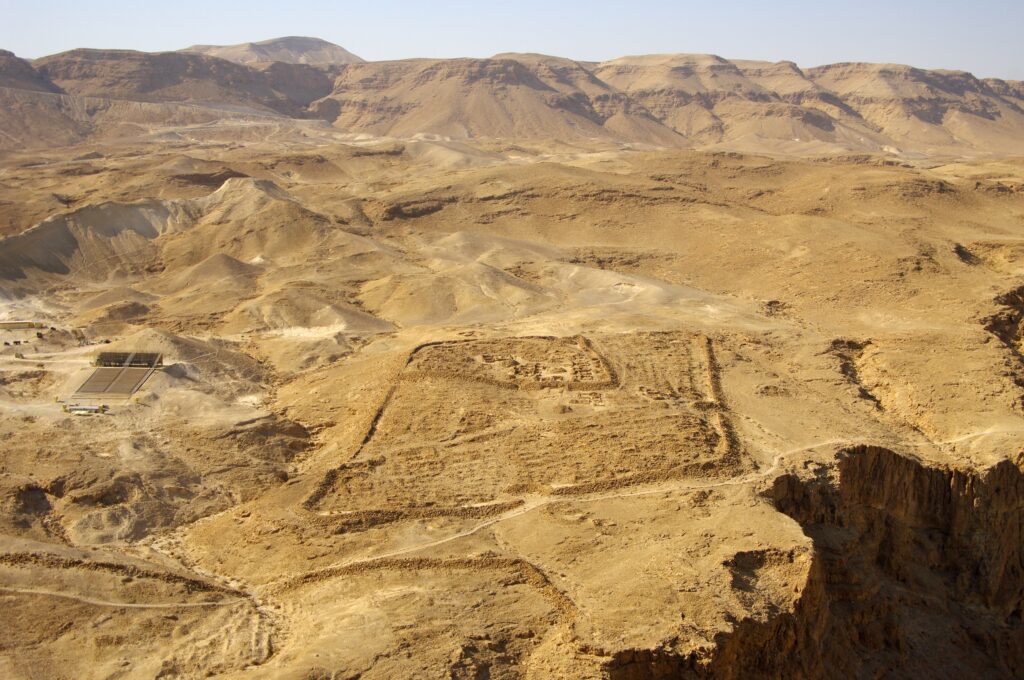
But pockets of resistance remained elsewhere; groups holed up in strongholds like Masada and Herodium. Masada was the last place to hold out, and hold out they did. The small band that had retracted there was self-sufficient in the desert fortress, supplied with cisterns of water and stored foods such as wine, oil, grain, and fruit. (Magness)
The Jews might have been stubborn, but Roman pigheadedness, especially in war, knew no bounds.
There were fewer than a thousand Jews in Masada, but eight to fifteen thousand Romans encamped below the clifftop. A significant proportion of the Jews must have been women and children, so the Roman response was overkill.
The Jews held out for three to four years, because they occupied the higher ground. They pelted the Romans using slingshots, which are surprisingly deadly, while the Romans spent their days building a ramp up to the fortress.
According to myth, by the time the Romans had broken through, the Jews had soured their victory with a mass suicide. This story is refuted by archaeologists, but the myth endures (Beard). What is certain are the terrible final moments of some of the inhabitants:
Upon the steps leading to the cold water and on the ground nearby were the remains of three skeletons. One was that of a man of about twenty – perhaps one of the commanders of Masada. Next to it we found hundreds of silvered scales of armour, scores of arrows, fragments of a prayer shawl (tallith), and also an ostracon (an inscribed potsherd) with Hebrew letters. Not far off, also on the steps, was the skeleton of a young woman, with her scalp preserved intact because of the extreme dryness of the atmosphere. Her dark hair, beautifully plaited, looked as if it had just been freshly coiffeured. Next to it the plaster was stained with what looked like blood. By her side were delicately fashioned lady’s sandals, styled in the traditional pattern of the period. The third skeleton was that of a child. (Magness)
The Second Jewish Revolt
As mentioned above, huge swathes of Jews were deracinated after the war, which was known as the First Jewish Revolt. But some stayed, or returned, to fight again. In the 130s CE, they conducted guerrilla campaigns against the occupiers, because they knew the countryside better than the Romans. The Jews even wiped out a Roman legion! But during this, the Second Revolt, Rome’s retribution was decisive. Emperor Hadrian set about wiping the city’s Jewish identity by rebuilding it as a Roman city. (Magness)
The aftermath
Judaism survived, albeit the Jews were scattered, and worship moved into synagogues instead of being centred on the great temple. Theirs is an amazing story of endurance. But the sad reality of occupation does remind me of something my grandparents’ generation (on both sides of WWII) said: Why did we bash each other’s heads in? What was it all for? Indeed, round and round it goes, all over the world, again and again, the stories of the oppressors and the oppressed.
We may have started this post with jokes, but this final sentence is not the place for one.
Further reading for the curious
Armstrong, 1997, History of Jerusalem: One City, Three Faiths, Harper Collins.
Atkinson, 2012, Queen Salome: Jerusalem’s warrior monarch of the first century B.C.E., McFarland & Co.
Beard, 2016, Empire Without Limit, Documentary series.
Charlesworth, 2014, Jesus and Temple: Textual and Archaeological Explorations, Augsburg Fortress.
Goodman, 2007, Rome and Jerusalem: The clash of ancient civilizations, Allen Lane.
Grabbe, 2010, An Introduction to Second Temple Judaism, T & T Clark International.
Magness, 2010, The Holy Land Revealed Series – Lecture Series.
Magness, 2012, The Archaeology of the Holy Land, Cambridge University Press.
Rocca, 2008. Herod’s Judaea. A Mediterranean State in the Classical World, Mohr Siebeck.
Schwartz, 2001, Imperialism and Jewish Society, 200 BCE to 640 CE. Princeton University Press.