
Etiquette in Xerxes’s court
Trigger warning: This post contains graphic descriptions of punishment and mentions genocide.
Persian kings liked to impale their enemies, including those at court. The simplest faux pas, like failing to honour a superior, could see you skewered. Someone with irreverent humour and who can’t be bothered with formalities, like me, would have lasted about 75 seconds. In this post we look at weird and wonderful social mores in ancient Persia during the time of the biblical Queen Esther (she probably didn’t actually exist, but let’s say she did). We tell the tale from Esther’s point of view, because she was the one who dared to defy custom. Most of the research in the post is taken from Llewellyn-Jones, a fascinating book that brings this period to life. Where we deviate, we throw in references from other sources.
Setting
The story of the biblical Queen Esther was written around 400-350 BCE. It is set in Persia, in what is now modern day Iran. We can’t quite pinpoint her in history, but if she existed, she was a young woman during the reign of either Xerxes I, Artaxerxes I or Artaxerxes II. We’ll follow convention and pick Xerxes, because his reign best fits the narrative and his name is the easiest to pronounce. Xerxes was the Persian king whose ginormous army was held back by 300 Spartans in a narrow coastal pass. In the movie 300, Xerxes was the bald, clean-shaven dude in the racy golden jockstrap and body chains, who was transported on a giant staircase/throne, literally on the backs of slaves. I love that film, but assume that scholars raised a sceptical eyebrow at this depiction. For a start, Persian kings boasted long hair (amplified with wigs or false tresses if required) and thick beards (again, plumped out with false beards if required), and didn’t rock up naked to war and public engagements. I wonder which version, if any, appealed to Esther? What we know for sure, from the story at least, was that she appealed to him.
Esther’s obscure origins
Esther was a member of a sizeable Jewish population in Susa, Persia. The Jews had been taken to Babylon in 587 BCE, after the Babylonian conquest and destruction of the Kingdom of Judah. Some decades later, the Persians conquered the Babylonians, and the Persian king, Cyrus, issued an edict that let the Jews return to their homeland. But some, like Esther, stayed in the east.
Susa was a city-palace in the foothills of the Zagros Mountains. It wasn’t the capital per se, but one of regular stops on the royal annual nomadic progression around Persia. The royals followed the weather: summer was spent in the cool mountain plateau of Ecbatana; winter in balmy Babylon and Susa; and spring in Persepolis and Pasargadae.
Esther lived all year round in Susa, a scalding place, where a lizard was said to fry before it finished crossing the road in summer. The royal buildings were made of stone and wood, everyone else in residence (courtiers, the army, civil servants) lived in tents or temporary constructions. While Esther’s story takes place in the enclosed citadel in the north, it could be assumed that she grew up in its shadow, since the so-called citadel was made up of the royal palace, audience hall and temple. Her cousin, Mordecai, was a spy for Xerxes, so may have had access to the citadel, but seemed to spend a lot of time at the gatehouse passing messages to Esther to give to Xerxes, rather than passing them on himself.
We don’t know much about Esther’s background, other than that she was a young Jew who concealed her ethnicity when she arrived at court. The most likely reason was because several courtiers were Amalekites, long-time enemies of the Jews.
Queen Vashti
Persians loved a good banquet; sometimes the king invited thousands of people. We’re talking seven to ten days of feasting in gardens among hanging linens, on gold and silver couches, attended to by wine stewards, and enjoying extensive menus:
Rich meats, including horse, camel, oxen, wild asses, deer, Arabian ostriches, as well as a variety of geese, were served with various types of bread, sweet grape jelly, candied turnips and radishes, candied capers with salt, terebinth oil, saffron, nuts and huge quantities of fruit – quince, pear, dates, pomegranates, figs, apples, raisins and almonds. (Llewellyn-Jones)
Women and men banqueted separately. It was during one of these banquets that Esther’s biblical journey began, even though she, herself, wasn’t present. Xerxes’s then queen, the looker Vashti, entertained her women lavishly under the awnings, out of view of the men – a woman’s prestige lay in “her separation from the gaze of strangers.” Then, Xerxes made, in Aussie terms, a bit of a dick move. He ordered Vashti to come to him, leaving her in a catch-22:
Her summons requires her to choose between two contradictory obligations – the rules of etiquette prevent her from appearing, but the king’s order compels her to go. (Llewellyn-Jones)
Vashti refuses to go, loses her crown and is shunted to the darkest corner of the harem.
It’s safe to say that Xerxes had a bit of an anger problem and suffered from a dose of masculine toxicity. He demanded a better, more obedient queen, and put the word about town (well, put the word about his vast empire that stretched from Ethiopia to India) that he was looking for a new queen.
Xerxes
Why does he come across as such a man-baby? I assume that it had a lot to do with his self-image, and arguably even more with how his subjects viewed him. The king ranked as semi-divine, the great god Ahuramazda’s hand on earth, and everything was done to make him appear and feel that way.
The monarch’s clothed body emanates strength and vitality, his posture encodes military prowess and sportsmanship; his hair and his beard are thick and luxuriant and radiate health and vitality; his face, with its well-defined profile, large eyes and thick eyebrow, is as noble as it is handsome. The Great King is, in all ways, a thing of splendour.
…
On top of the Great King’s coiffured and oiled locks sat a crown, weighty with symbolic authority. (Llewellyn-Jones)
On any given day, Xerxes chose between one of two outfits. (No, the golden jockstrap wasn’t one of the options.) He was either in “riding dress” while on the road, wearing a felt cap, a sleeved coat, sleeved tunic, trousers and footgear, or “court robe,” donning an enormous ornamented, belted robed over his trousers and tunic (Anderson).
His feet weren’t allowed to touch the ground. He was transported around on a bench throne (a seat or couch) outdoors, although not quite the monstrosity from 300. Whenever he sat on his throne, he used a footstool. While walking the palace, his precious tootsies were protected by soft carpets. The long list of rules that he was subject to sounds stressful and annoying, or maybe I’m just hung up on the soft carpet rule because like most Aussies, I relish the feel of sand on my bare soles.
The king ate alone, which might have been lonely or a welcome relief from protocol. “Alone” is a matter of perspective – servants still hovered over him. On the rare occasion when his wives, sons or guests ate with him, there was a strict seating order, depending on who he held in esteem. Yet another source of stress for Xerxes? Most people only have to organise seating arrangements for weddings, and even that can cause a furore.
Afterwards, his oft-lonely meal, his mates joined him for a drink. By “join,” I mean he lay on a golden couch and they were scattered around him on the floor.
Persian society at this time was considered pyramid-structured, with a large worker base at the bottom, a few nobles in the middle, and the king on top. So, how did Esther rise to the very top? Well, Persian kings apparently had a type…
Beauty and the harem
The ideal Persian beauty is described as:
‘having white arms, strong, plump, of great stature, young and tall, with prominent breasts, delicate skin’
…
with full, plump, cheeks. Eyes are large, noses are prominent and mouths are tiny and bud-like
…
fat, the best feature of female beauty… the somewhat inactive or secluded lives of many aristocratic women in ancient Near Eastern societies, a tendency to run to fat was commonplace.
…
radiant (Llewellyn-Jones)
I can’t imagine the boredom of being a penned up, exotic animal who glowed like she’d been covered in radium paint.
Esther must have borne all these esteemed qualities, because she was conscripted into the imperial harem. As a side note, the royal apartments were somewhat of a maze, deliberately difficult to access, for the privacy and safety of the royal family, and presumably just as difficult to escape. There, she and the other novices were subjected to an intensive beauty treatment and were trained in court etiquette to make them even more desirable. Their skin was lightened with pastes and they were lavished with perfumes, their hands and feet stained with henna, eyes lined, eyebrows thickened.
Grooming and training took a whole year, before they were presented to the king. Esther was the winner of Xerxes Wants a Wife, actually – Xerxes Wants a Queen – she ascended to the top with the speed of a reality TV star, bypassing all other concubines and wives.
It should be noted here why Queen Esther is probably not a historical figure. (1) There’s no record of her. (2) Non-Persian women were not consorts during Xerxes’s reign, neither were women who weren’t of noble birth.
Esther approaches the king
Before we launch into Esther’s first act of bravery, let’s paint the scene. The royal palaces were vertiginous, designed to remind you of who’s the boss. The entrance itself dwarfed the mere mortal who dared to pass through:
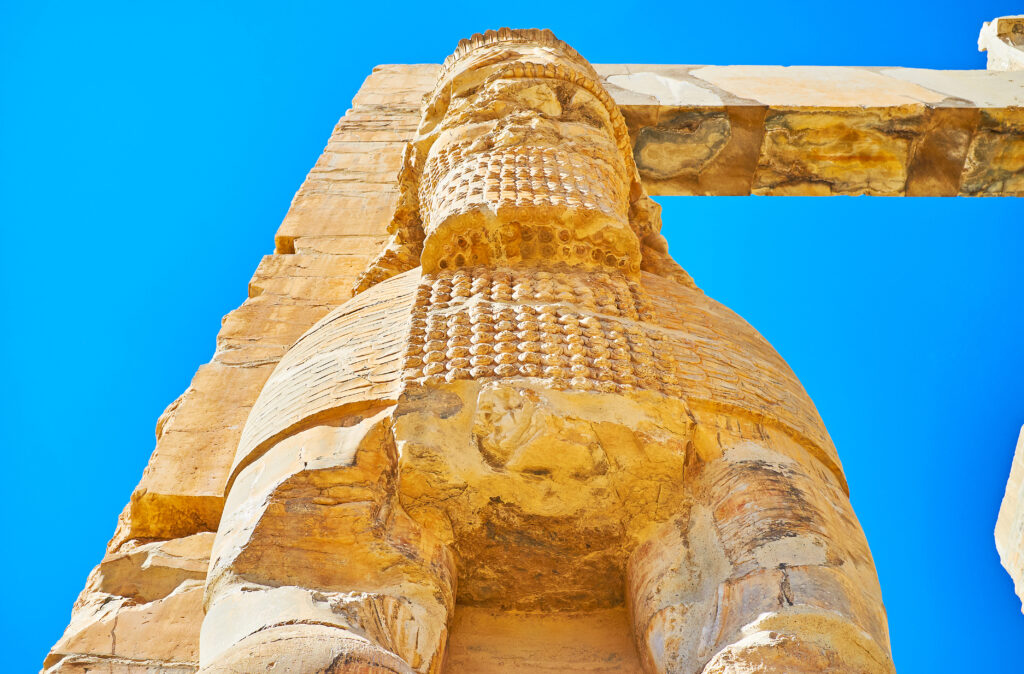
Access to the palace from the Royal City was on a pavement of bricks. This pathway passed through a monumental, covered square pavilion, which had two halls and two porticoes with columns… Turning at a right-angle, the road then crossed a brick causeway and ended at the Gate of Darius, another square construction with a hypostyle central hall. … It was the official entrance to the palace and was flanked by two larger than life-size statues of Darius [Xerxes’s father]. (Llewellyn-Jones)
The throne hall continued in the same vein:
The enormous square construction is a little elevated above the open space that surrounds three sides. Measuring 109 metres on each side, it has a central hall of 58 metres per side, with 36 columns, topped with massive double-bull-shaped capitals, supporting a cedar wood roof, and a portico on each of the three open sides with two rows of six columns. (The plan of the south side is unclear.) (Llewellyn-Jones)
This building was huge. It was here where young Esther approached the king, a diminutive creature under the imposing columns.
The event was instigated by her cousin, the spy Mordecai (hehe – that rhymes!), who learned about an assassination plot against the king. Mordecai rushed to meet Esther in the tall, echoey gatehouse that demarcated the palace from the rest of Susa. As a side note, even eunuchs had to keep seven paces away from the women in the harem, so I wonder whether Mordecai broke protocol in order to tell Esther about the scheme? It’s hard to imagine him keeping his distance and shouting out the details. So many rules! Mordecai seemed to think that she had better access to the king than him, possibly because he was a low-level spy, so he told her to pass on the news.
Esther rushed to the king in the throne hall without being called for by name – another major no-no. Xerxes was pleased to see her and extended his sceptre, allowing her to speak.
After hearing the news, the king rewarded Mordecai for his service with the king’s horse and garments, a great honour indeed, even more so than a tennis player throwing their sweaty shirt into the crowd.
The would-be assassins were, of course, impaled:
Stripped naked, the condemned was positioned on top of a long, sharpened wooden stake that entered his body through his anus. The process of dying was a long, drawn-out, and agonising affair that lasted for many hours, sometimes for days. The cause of death was via shock, body-trauma, loss of blood and blood poisoning. (Llewellyn-Jones)
It was often a public death too. Let this be a warning to the rest of you…
Haman
Mordecai’s sudden rise annoyed Haman the Amalekite, a close advisor to the king – a Disney Jafar type of character. No shoulder-parrots are mentioned in the Hebrew bible, but Haman’s wife did have a habit of whispering in his ear. (More on that below.)
Haman was rankled because Mordecai refused to fall to his knees before his illustrious personage. Mordecai most likely refused to kneel because Haman was an Amalekite, a foe of the Jews.
Haman raged about Mordecai’s insolence to his wife, who told him to set up a pole, measuring no less than 50 cubits (~23 metres), to impale Mordecai. If a 23 metre pole isn’t public, I don’t know what is.
Plotting to kill Mordecai wasn’t enough for Haman. He went to the king to ask for permission to annihilate all the Jews because:
their norms are different from those of all the other people, and they do not obey the king’s laws; it is not in the king’s best interest to put up with them. (Llewellyn-Jones)
Xerxes, in another dick move, agreed that genocide was the only course of action for a whole group of people who supposedly didn’t obey him. He issued a decree to annihilate the Jews on the thirteenth day of the month of Adar.
Esther approaches the king again
Esther learned about the decree because Mordecai, dressed in rags, mourned at the king’s gate. The sartorial police didn’t let him in because he was dressed in a sackcloth – mourning clothes were not permitted in the citadel. More rules!
Again, Esther agreed to speak to the king. At this stage Esther hadn’t been summoned by the king for more than thirty days, so may have fallen out of favour. Palace rivalry was intense – another woman might have gained an emotional or sexual hold on the king. Cue the dramatic music.
She went to him without being summoned a second time. Again he was pleased to see her and extended his sceptre, permitting her to speak. (Did he have one bigger arm, like tennis players, given all the reps he did with the sceptre?)
Esther revealed that she was a Jew, and asked for permission for the Jews to defend themselves on the thirteenth day of the month of Adar. The king, smitten with his queen, granted her request.
The plot was more involved than described above. For one, it included more banqueting (naturally). But the long and short of it is that the Jews successfully defended themselves, and Haman ended up on the very high pole that he’d set up to skewer Mordecai.
Aftermath
Esther’s story is part of the Hebrew bible, and her bravery has been celebrated since it was first written down around 400 – 350 BCE. While she may not have been a historical figure, the writer showed great knowledge of social mores in Persia at the time. There are more customs that we haven’t discussed here, like the importance of marking space with incense burners, the king asserting his dominance by standing on the necks of his enemies, how to mourn professionally, … I was overwhelmed when I read Llewellyn-Jones, and I wondered about Esther’s past, what customs she did or didn’t know, and how much she had to learn during her year of training before she was presented to the king. One aspect that’s missing from the biblical story of Esther is how, or if, she integrated her Jewish customs into her Persian life. She was incredibly brave, so I like to imagine her sneaking in a prayer, or carefully selecting food to try to keep kosher. As said, she likely wasn’t a historical figure, but her story showed how someone (a lowborn woman, no less) could navigate the many and varied customs of the Persian court to save her people from annihilation. Esther is still commemorated annually during the Jewish holiday of Purim.
Further reading for the curious
Snyder, 2006, 300.
Llewellyn-Jones, 2023, Ancient Persia and the Book of Esther, I. B. Taurus.
Anderson, 2025, Persian Power Dressing.