
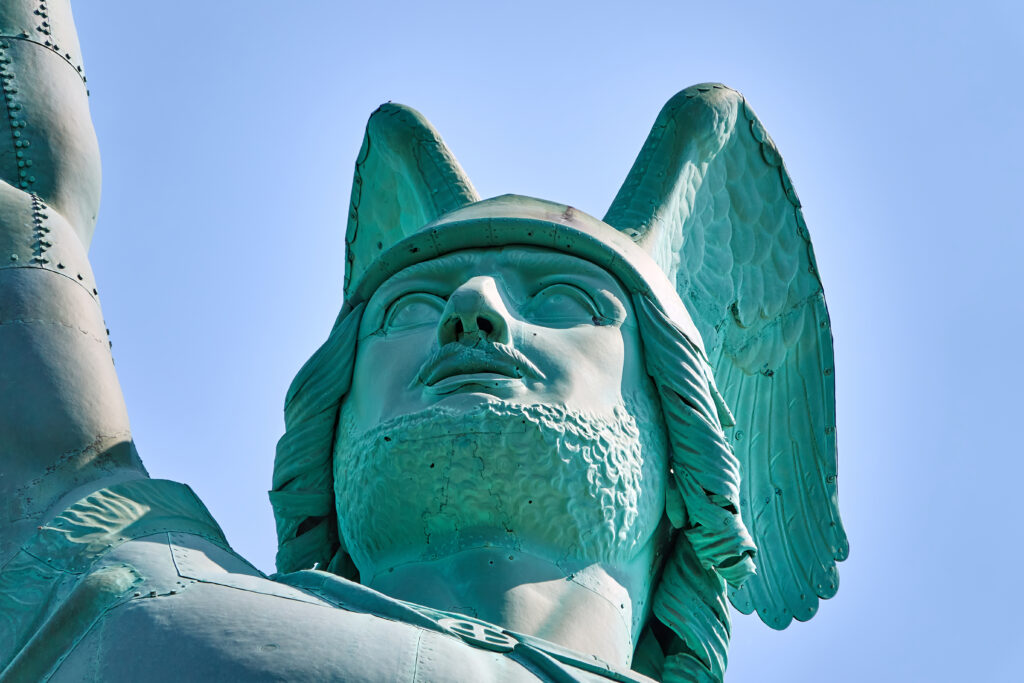
Fighting Roman oppression
Dear Romans
Marching in a long, thin line through densely forested enemy territory is a really dumb idea. Also, don’t call us Germans.
Yours sincerely,
the Aduatuci, Batavi, Caeraesi, Chatti, Chauci, Cherusci, Condrusi, Eburones, Frisii, Harudes, Hermunduri, Marcomanni, Marsi, Nemetes, Nervii, Paemani, Sedusii, Segni, Suebi, Sugambri, Tencteri, Ubii, Usipetes, Vangiones
Spring and summer were perfect seasons for conquest. Roman soldiers stretched their legs and awakened their sword arms after the long, dark winter months. They had previously ventured north, through the alps and to the west of the Rhine. Itching for more territory, they pointed their swords eastwards. And failed. Because there they encountered various tribes, the so-called the Germani, who revelled in a bit of summertime campaigning themselves.
My German identity
A few months ago, when I was filling out the Australian census, I came to the question of ancestry. I paused. My paternal grandfather was Slovenian-Austrian-German, my paternal grandmother Serbian-Austrian-German, my maternal grandfather Austrian, and my maternal grandmother Romanian-Austrian-German. The box in the online form wasn’t big enough for all that.
For those who are confused, let’s start with the difference between Austrians and Germans. In the time of the Habsburg empire, 1278 to 1918, the Habsburgs, a family with long, regal chins, ruled over Austria – huge swathes of land that included Germans, Hungarians, Czechs, Slovaks, Poles, Ruthenians, Slovenes, Croatians, Serbians, Romanians, Jews, Italians and Ukrainians (Palmer). There were also non-Austrian Germans, who lived in a loose confederation of states to the north.
Germans from both groups spread across Europe for hundreds of years, disseminating vital exports like cured meats, delicious cakes, frothy beer and cringeworthy accordion music. In sacks and on travel wagons, they also carried some rather insular ideas of superiority. They even directed racial slurs at their own: my Austrian great grandmother refused to meet my grandmother because she was born in Romania and was therefore labelled a gypsy. The bigotry wasn’t limited to her, nor did it completely fade with time… Don’t mention the war. For the ancestry question in the census, I was tempted to put a smart-arse response: “self-important and embarrassing,” and maybe add “great bakers,” to make it less negative.
For all their ethnic pride and invading their neighbours to create little Austrian-German enclaves, my ancestors were unaware of a pertinent fact: there was no such thing as a German before Julius Caesar (Wells)…
First encounters
The Romans first encountered “German” tribes when these tribes swept southward in great numbers before 100 BCE, munching their way through Gaul and Italian lands. “Not for them tilling the land.” (Powell) Why bother when someone has planted the crops for you? If you’re interested, no one describes this period better than
McCullough. The savage clashes between the marauding northerners and Romans set the scene for future encounters: each side invading the lands of the other and warfare that resulted in great losses.
Caesar and the so-called Germani
When Caesar conquered Gaul before 50 BCE, he ultimately drew to a pause at the Rhine, which became the natural barrier of the Roman empire. Beyond it lay ominous forests and wild men…
Caesar lumped together everyone who lived to the east of the Rhine (and some groups that immigrated to the west of the Rhine, but who were distinct from the Gauls) as the Germani. They didn’t call themselves Germani. They saw themselves as distinct, and often squabbling tribes (Okroy and Voelker), not limited to the list in the mock introductory letter to this post. As a side note, I was recently in Dresden, which is well east of the Rhine, and was surprised by the number of different German dialects I heard; perhaps there’s still no such thing as a German?!
Caesar wasn’t flattering about the Germani, calling them simple and barbaric. (Goodman) We’ll look at some weird and wonderful Roman descriptions in
Tacitus.
Alpine Encounters
After Caesar, the Romans had subdued Gaul to the northwest, but hadn’t yet conquered the alpine lands of the ancient Bavarians, Tyroleans, and Swiss Germans – basically everyone who loves yodelling. The Romans knew surprisingly little about these people with whom they lived in close proximity, other than blaming the harsh wilderness for making them barbaric. The Raeti, as they were known, were considered half-Germanic, and were socially similar to the Celts (Powell).
A bit about the Celts (Powell):
- Their clans were ruled by non-hereditary kings, chieftains or magistrates.
- Among the non-aristocrats, honour was given to men who were bards, diviners and druids.
- They manufactured high-quality chainmail shirts, cuirasses, shields, and helmets. One of their weirder inventions was a cavalry helmet topped with a metal bird with flapping wings.
- They made and fought with javelins, swords and slingshots.
- They robbed the fallen dead because it was cheaper than making new stuff. Sorry, not “robbed” – the correct term is “won through combat,” my bad.
- They were master horsemen, in fact “the best mercenary mounted troops Roman money could hire.”
- Their armies used standards and musicians to rouse the warriors and direct battle, similar to the Romans. It’s worth googling “carnyx” for images of the bizarre long trumpets that towered above musicians’ heads.
- With their flair for colour and design, the Celts looked good both on and off the battlefield. They wore bright striped or chequered cloaks, glimmering gold and silver belts. Celtic bling was visible on shields and horse-wear, with silver embossed discs and dramatic emblems respectively.
We can assume that the half-German, somewhat-Celtic Raeti were a bit like the Celts: they looked great, fought hard and took one or two weird objects into battle.
They also had a wholesome, natural side: the Raeti bred cattle, made dairy products, felled trees, engaged in agriculture and “traded their surplus of cheese, honey, pitch, resin and wax” (Powell). They enjoyed, if not a peaceful, then a fruitful existence, set against a Sound of Music backdrop…
Until Roman houses began popping up amidst the conifers and pine trees.
The Raeti welcome wasn’t pleasant. They raided Roman settlements, harassed travellers, and erm… killed all males, including unborn children who the diviners “saw” to be male.
Rome didn’t put up with the yodellers’ “diplomacy by other means.” Both sides fought bitterly for control of the Alps. While Rome had strategy and technology, the Raeti possessed ferocity and superior knowledge of the mountainous terrain (Powell).
Ultimately, Roman battle formations and discipline overpowered the raucous barbarians. Male Raeti of fighting age were subsumed into the Roman auxiliaries, and in the time of Augustus, around 2000 years ago, the “Roman armies now had control of all the major passes of the Alps, connecting the Mediterranean world under Rome’s influence through the Voralpenland of Southern Germany to the banks of the River Danube” (Powell). Raeti lands became a Roman province, their farmland confiscated for retired soldiers.
Rome, being Rome, wanted more.
Tacitus
Before we get back to the slaughter and mayhem, let’s take a look at how the Germans were described some hundred years later by Tacitus, who was a little kinder than Caesar, but not much. I have cherry-picked some examples, and added some observations from the present (Tacitus):
- They have songs called baritus, the recital of which stirs up their courage in battle. Fair, we still enjoy a good sing-off, like when Conchita Wurst won Eurovision in 2014.
- Appearance: blue eyes, red hair, large bodies. Some of us have brown eyes, brown hair, and small bodies, but then again my siblings do call me a runt.
- They live in cold areas, surrounded by forests and marshes, and are therefore dull and primitive. You try looking lively in that environment before the time of coffee.
- The peoples of the interior, being simpler and more old-fashioned, barter instead of using coins. My granddad did paint someone’s house in return for vegetables and a chicken.
- Only a few use swords or large lances. They carry spears… Even their horsemen are content with just shield and spear. We have now evolved and use more complex tools, such as the leatherman.
- In battle they have their nearest and dearest close by… Their family does not shrink from counting and examining their cuts that they got with their wounds. This is a true and adequate description of our family soccer matches.
- Germans made excellent cavalrymen. “Germanic cavalry would often dismount and fight on foot and Caesar observed that they even trained their horses to remain standing in the same spot so they could leap up on to them and ride to another part of the battlefield or escape.” (Powell) Now we do the same with cars – truly, they don’t escape when we duck into the supermarket for groceries.
- They attach the highest importance to the taking of auspices and the casting of lots. Indeed, we are steeped in superstition. I’ll go out of my way to see a chimney sweep on 1 Jan for luck in the coming year, which is exceedingly difficult in Sydney.
- They do not reckon time by days, but by nights. All their decisions, all their agreements, are made in this way: night is seen as ushering in the day. Yeah well, daytime is for (a) eating, (b) planning your next meal (more on meals later).
- Their freedom of spirit involves a drawback, in that they do not assemble all at the same time or as if commanded, but take two or three days over it, hanging back. Lies! We’re annoyingly punctual.
- Silence is commanded by the priests, who have on these occasions the right to enforce obedience. That does sound like the Catholic services I attended as a kid.
- They transact no business, public or private, except under arms. Shamefully, one or two more recent world wars attest to this.
- Women, children, the old and the weak are left to do mundane tasks such as “caring for the house, home and field.” A priest did ask why I wasn’t doing woman’s work when I told him I enrolled in an engineering degree.
- Their houses are separated by open spaces; the Germans do not live close to their neighbours. Lies! We live in close proximity in order to gossip more effectively.
- They dig underground caves and load piles of manure on top of them, as a refuge. Everyone had a fallout shelter during the Cold War.
- They wear tight-fitting trousers and animal skins. The latter is absolutely true, about those people who want to get doused with paint.
- There is no worth attached to childlessness. The awkward question of offspring does tend to come up.
- Gambling is rife. True. In the 1800s we even bet on snail races (McCraw).
- No one thinks it disgraceful to carry on drinking all day and all night. … This people is neither cunning nor subtle: in the freedom of such surroundings their inmost feelings are still expressed. For drink they have a liquid made out of barley or other grain, fermented into a certain resemblance to wine. We gave you good beer. You’re welcome.
And lastly, most importantly:
- No other people indulges more lavishly in feasting and entertainment. It is regarded as a sin to turn away any person from their house. Each according to his means receives guests with an elaborate meal. Absolutely. There is no greater terror in a German/Austrian home than running out of food when someone pulls up in your driveway.
Contemporary sources
The literature (and documentaries) gives a more nuanced view of the so-called Germani. Below is a summary of
Wells and
Okroy and Voelker, which found the German tribes to be more than just large, spear-wielding thugs who spent all night drinking, while simultaneously holding counsel under the new moon. (The summary is also more informative, albeit drier, than the previous section, because I showed restraint and didn’t add the usual smart-arse commentary. Depending on how you’re wired, you may prefer it, or want to skip it.)
Homes
Many Germans lived in villages or on farmsteads. Some lived in long houses, held up by rows of timber posts, enclosed by external walls of wattle, sealed with clay, and topped with a thatched roof. People lumped in with their animals to keep warm, no doubt exuding a pungent odour that would floor us today. The houses were arrayed somewhat haphazardly, not planned like the perfect rectilinear Roman town.
Food
They cultivated wheat, barley and rye, peas and lentils, raised cattle, sheep, goats and pigs, although meat was rare, likely due to its
cost in antiquity. They ate gruel, berries, mushrooms and nuts using wooden tableware.
Clans and warfare
The German clans and warfare have been described in almost idyllic terms (Powell), as free spirited, enjoying a democratic form of self-rule… “They choose their kings for their noble birth.” In times of war, one hundred of the ablest young men were selected from their villages to accompany the cavalry on foot. War was allegedly conducted with skill and using battle formations. As we’ll see later, in the
Battle of Teutoburg Forest, it seemed more likely that an unruly mass of ferocious men pounced on the unsuspecting enemy, sticking them with whatever blade they had to hand.
Women
In
Tacitus, women are painted as fearsome supporters of the men in battle, whether that meant haranguing from the sidelines, bringing food or inspecting gashes.
While Tacitus did mention that the Germans sometimes venerated women, especially prophetic ones, he doesn’t mention the wide range of duties and tasks that came to light in later archaeology. One key example was the midwife, who played an important role, using medicinal herbs to help during the
pregnancy and childbirth, which were always dangerous in antiquity.
Hierarchy and slaves
While tasks might not have been as delineated as in a Roman home, families and slaves existed in some semblance of hierarchy, which often depended on familial bonds.
Technology
Metallurgy was more well developed than the Romans made out, the Germans forging weapons and tools. They made wooden and stone tools, pottery, and bartered with bronze ornaments and beads.
Clothing
Germans were more than a pair of muscular legs in barbaric trousers. The wove wool and linen, mastering delicate herringbone patterns. They loved colour, purple and red dyes from earth, plants and snails.
Sacrifice and the gods
Caesar said that Germans had no druids to preside over matters related to the divine, and had little enthusiasm for sacrifices. “They count as gods only those phenomena that they can perceive and by whose powers they are plainly helped: the Sun, Fire, and Moon; others they do not know even from hearsay.” (Mueller)
He was wrong. Offerings were made in sacred places in nature, rather than temples. Requests were made of the gods, e.g. priestesses asking the Mother Goddess (earth goddess) for blessings in the coming year. Like other communities in antiquity, large animals were sacrificed by the community, and eaten by the community.
They believed that the gods were omnipresent in nature and played a role in human destiny. The gods often came in male/female pairs, wooden idols – huge, stylised human figures. It is fitting, and sad, to note that the female gods faded after the Romans came, and that the gods of war became more prominent.
Roman conquests of Germanic lands
One of Tacitus’s lasting remarks is that German tribes cut their neighbours to pieces… “Long may the barbarians continue… to hate one another,… fortune can offer no greater boon now than discord among our enemies.” But, as Tacitus well knew, there were indeed times when discordant groups of Germani banded together to fight a common enemy…
While Caesar allocated the Rhine as a natural border, it didn’t stop the Romans from crossing it.
For a while, the German tribes fought each other. Some even called for help from the Romans against their neighbours (Livius).
Eventually the Romans itched for conquest of these lands. The Germans fought back.
In 17 BCE, three powerful tribes, the Cherusci, Suebi and Sugambri, retaliated by setting twenty Roman centurions on fire and stealing a Roman cavalry’s eagle standards (Powell). Losing an eagle was almost a greater tragedy than losing the centurions –
The Eagle of the Twelfth is a great read about Roman obsession with retrieving lost standards.
The clashes continued until 8 – 9 BCE, when Rome had conquered many Germanic tribes (Okroy and Voelker). All the tribes between the Rhine and the Elbe submitted and paid tribute to Rome, who “disregarded the law, customs, values of the Germans, that had been handed down for generations” (Okroy and Voelker). The new governor of Germania, Publius Quinctilius Varus, was particularly oppressive and unjust.
He was also a bit of a fool. Instead of taking a standard military road from east to west (back to the safety of a Rhine-based fort of Vetera, modern-day Xanten), he let Hermann the German get in his ear…
Arminius and Teutoburg
“The Cherusci have gone down in history as the tribe that produced Arminius, or Hermann the German, who defeated Roman ambitions at Teutoburg in 9 CE.” (Powell) The son of a Cherusci nobleman, Arminius was one of a handful of pro-Roman sons educated in and allied with Rome. Romans were convinced that taking foreign children hostage and raising them in Rome would turn them into real Romans. It worked for a while, Arminius having joined the Roman army, but when he returned to his tribe and witnessed the subjugation of his people, his sentiment changed.
Having been trained in Rome, Arminius understood Roman battle tactics, how their army fought, the power in their well-formed battle formations. He knew that Romans feared the forest, and couldn’t fight their way out of a copse. And so he fabricated a story. He told Governor Varus that there was unrest on the standard military road, and it was altogether better to cut through Teutoberg Forest.
Varus trusted him, because Arminius was raised in Rome. Varus agreed to send his army westwards in a long, thin strand, through shadowy and unnerving Teutoburg Forest. Oh Varus, you fool.
Arminius had united all the warring German tribes, who were hiding on the slopes, behind tree trunks, watching the silver serpent of the Roman army as it snaked its way through the thickets.
The Germans attacked with everything you’d find in a garden shed: axes, spears, the odd sword, wooden or and iron-spiked clubs, darts, arrows, slingshots… Ok, maybe not everyone’s garden shed.
The 17th, 18th, 19th legions and their auxiliaries were ambushed and slaughtered; in total some 20,000 soldiers and accompanying civilians were killed. Once again, Rome’s eagle standards were nicked.
The aftermath
When he heard the news, Emperor Augustus moped about in his palace, lamenting in a Shakespearean fashion, “Quintilius Varus, give me back my legions!” (Suetonius)
Despite his dramatic tears, “Augustus did not entertain the idea of giving up the annexed Germanic lands” (Barrett). His stepson, Tiberius, “quickly stabilised the situation,” as did Tiberius’s nephew.
The Roman retaliation was ugly, and went on for years. Germanicus (who was named after his father’s conquests in Germany) led “12,000 legionaries, twenty-six allied cohorts and eight troops of cavalry” across the Rhine , ravaged the land, wiped out the population over a radius of fifty miles… Men, women and children were massacred as they wandered helplessly about; buildings and the sacred grove of the goddess Tanfana were razed to the ground.” (Seager) Crucially, the Romans recovered two of the three lost eagle standards of Varus.
The German tribes, under Arminius, fought back, and more messy to-ing and fro-ing eventuated.
The war continued until the Romans decided that their campaigns had been “necessary to avenge Rome’s honour. Now that this had been achieved, the Cherusci and the other rebels could be left to their internal quarrels.” (Seager)
The Rhine effectively became the border of the Roman empire once more.
Notwithstanding the enormous losses, German retaliation against Rome was ultimately a success, curtailing Roman ambitions to the east of the Rhine. That’s not to say that Romans didn’t interact with the German tribes, mostly for trade. Among prized German exports were wigs (Olson), lumps of amber for making perfume (Olson), its cavalry (Okroy and Voelker), mercenaries for the imperial guard (Southern), and slaves (Powell). The Germans exploited each other in exchange for shiny Roman trinkets, which they flashed about town.
Some five to six hundred years later, when the western Roman empire was collapsing, the descendants of the Germans hit Rome and the southern lands in successive waves. It was their turn to invade. As time passed, they took their place on the stage of world history as Germans, and in Austria. Starting in the 1100s, they began to infiltrate lands to the east and south, which eventually led to my ancestors foisting cured meats, delicious cakes, frothy beer and cringeworthy accordion music on Romanians and Balkan people. Some of us have travelled as far as Sydney. I wouldn’t exactly say that I stem from a successful people, but my pantry is packed with goodies in case someone drops in.
Further reading for the curious
Barrett (ed), 2008.
Lives of the Caesars, Blackwell Publishing Ltd.
Goodman, 2007,
Rome and Jerusalem: The clash of ancient civilizations, Allen Lane.
Livius.org,
Germania Inferior.
McCraw, 2007,
Prophet of Innovation: Joseph Schumpeter and Creative Destruction, Harvard University Press.
McCullough, 2003,
The First Man in Rome, Penguin.
Mueller, 2020,
The Pagan World: Ancient Religions Before Christianity, Lecture Series.
Okroy and Voelker, 2007,
The Germanic Tribes. Gruppe 5 / WDR in collaboration with arte, MDR & HR.
Olson, 2008,
Dress and the Roman Woman: Self-presentation and Society, Routledge.
Palmer, 1903.
Austro-Hungarian Life in Town & Country, George Newnes.
Powell, 2011,
Eager for Glory: The Untold Story of Drusus The Elder, Conqueror of Germania, Pen & Sword Military.
Scott, 2012,
Rome: The Eagle of the Twelfth, Bantam Press.
Seager, R. 2005.
Tiberius,, Blackwell Pub.
Southern, 2006,
The Roman Army: a social and institutional history, Oxford University Press.
Suetonius, 121,
The Lives of the Caesars, Loeb Classical Library
Tacitus, 98,
Agricola and Germany, Poetry in Translation.
Wells, 2013, Chapter
The Germanic and Danubian Transfrontier Peoples from The Oxford handbook of warfare in the classical world, Oxford University Press